
News – Sheridan Media

The early days on the frontier were often brutal. Men did what they could to survive, and sometimes their vengeance against those other men who wronged them was carried out in a brutal manner. This story, about Mountain Man John Jeremiah “Liver-Eating’ Johnson, is one such story of brutal revenge.
In 1972, Robert Redford, who sadly passed away last week, on September 16, played the role of Johnson in the film, Jeremiah Johnson about the famous mountain man.
John Jeremiah Johnson was born New Jersey in 1824, and came to the mountains of Montana and Wyoming where worked as a trapper, miner and scout.
Cheyenne Weekly Leader, January 31, 1878 – Gen. Sturgis Talks About the Late “Liver-Eating”Johnson. The announcement of the death of “Liver-eating” Johnson, of the Yellowstone, caused the St. Louis Globe boy to interview Gen. Sturgis, whose guide he was during the pursuit of Joseph.
He said: “I met him when we were at the mouth of the Stillwater, and there engaged him as a scout on account of his knowledge of the country which we were to go over last summer.”
“And what do you know of his Indian fighting. General?”
“Personally, I know nothing; though, from all I heard, he had killed quite a number of Indians, by whom he was greatly feared.”
“That’s a rather peculiar nom de guerre he travels under. General.” “Well yes,” laughing “that’s the name he was known by, though, universally—’Liver-Eating Johnson’—and I have no doubt earned it honestly. He was as you may readily suppose, quite a character. I never heard the full particulars of his liver-eating exploit; but I have the best reason in the world for believing its truth—he told the story himself.”
“He possessed the accomplishment of truth, then, among others’?”
“He was a perfectly truthful man. In all my dealings with him I never knew him to deviate a line from the truth. He never professed knowledge which he did not possess. When it became necessary for us to go into a part of the country with which he was unacquainted, lie at once acknowledged his ignorance; and when he was lead ing us through territory which he pro fessed to know, everything he indicated concerning localities which we were to enter—where there was water, where there was none, where a hill would be found, where a short cut could be made —turned out exactly as he had stated.”
“What sort of a looking man was he, General ?”
“Looked like a quiet going farmer. He was a man of fifty-one years of age, stoutly and powerfully built, with a sober, resolute face, dark hair and eyes, and heavy black beard.”
“Quite picturesque, then ?”
“No, he wasn’t at all picturesque. He might have been if he chose, but these guides, as a rule, make no attempt at personal adornment, and Johnson in particular, was utterly regardless of his clothes. Ho was very carelessly dressed at all times; consequently it was impossible to guess at his merits from his personal appearance.
Well, well, I’m sorry he’s dead, but (looking at the slip again) it doesn’t say how he came to be killed. Have you heard any further particulars.”
“Nothing further than what you see there. Maybe he has been killed in a fight probably.”
“I hardly think so. Very few people in the country would care to engage him, and he never sought trouble. On the other hand, he always avoided personal encounters, though when he was forced into one he could take care of himself admirably. No, I do not think he has fallen in a fight. I see by the report that the impression may arise that he killed Indians while he was with me. He was not present at the fight.” “How did that happen, General?”
“The day before I caught the Indians I sent him off from the mouth of Rocky creek, on Clark’s Fork of the Yellow stone, toward Crow agency, to intercept the supply trains and bring them up.”
“I suppose there were occasions when ho was invaluable to you?
“Yes, indeed, and never more so than when I crossed the river in order to go to Miles’ relief, fearing that Sitting Bull might come to the rescue of the captured Indians. I heard that he had intercepted the Nez Perces, so I crossed the river with the whole command to the scene of the fight. Johnson was my guide on that occasion. Everything depended upon him—no one else in the command knew anything about the country we had to traverse— and he led us straight to our destination.”
“What sort of a man was he socially ?”
“These men are pretty much alike. They live from hand to mouth; make a little money and spend it as soon as made; live principally by the chase and seem to have no care for the future.”
“Married or single ?”‘
“Oh, I’ve no doubt he was, or had been married. The marriage relation is not very seriously regarded in that country. Such men marry Indian women generally according to the Indian custom, but the relation is not considered very binding, and Johnson may have been married more than once.”
It was common for the trappers to marry into the Indian tribes but often deserted their Indian wives when they moved on, following the beaver or scouting for the army.
In the Cody Enterprise, Sept 5, 1923, there is a story about Johnson and how he got his name.
One of the most noted Indian fighters of the frontier, whose name has become one of the best known of all the old Montana trail blazers was “Liver-Eating” Johnson. Today, (1923) there are still living the state hundreds of pioneers who knew Liver-eating Johnson well.
“A sailor by occupation, he came from the Pacific coast to Montana in the 1860s, and being exceptionally expert with his rifle, was soon known as a bad man to impose on. He followed wolfing and hunting, with a big sprinkling of Indian fighting, for over 20 years.
The story said that Johnson gained his famous name in 1870. at the mouth of the Mussellshell river. He was at a trading post with several other wolfers, and a group of Indians attacked them and shot two of the woman, one was a wife of a wolfer. According to the paper, one of those in the party was George Grinnell.
The wolfer’s went to avenge the shooting of the women, and it was there that Johnson ate the liver (or took a bite out of the same) of one of the dead warriors. Later, he told his good friends that he didn’t really eat the warriors liver, but it made a good story, and he horrified eastern pilgrims with that other tall tales. Still, the name stuck, and everyone knew of Johnson.
Some sources say that it was the Crow Indians that killed his wife, and to avenge her death he killed over 300 Crow, scalped them and ate their livers. Later, Johnson made peace with the Crow and gave up his vendetta against the tribe.
The story tells that after the Indian Wars, Tom Irvin, of Deer Lodge, Mt., one of the early sheriffs of Custer County, knew Johnson well. He gave Johnson a job as a deputy to and stationed him at one of the Northern Pacific railroad camps, where he had heard of much trouble in the neighborhood. Concerned that Johnson wasn’t arresting and bringing in any troublemakers, Johnson told Irvine that he didn’t both to arrests the troublemakers, he just beat them up as a warning, and they didn’t cause trouble again.

Johnson, like many trappers and mountain men, scouted for the army after the trapping days were over.
The Sheridan Enterprise, August 22, 1920- Survivor of Last Indian Battle Here Man Who Fought Against Crazy Horse Is Here To Find Landmarks. Three miles south of Ranchester on January 8, 1877. What is said to have been the Last battle fought in Northern Wyoming occurred here between General Miles and the Indian chief Crazy Horse. One of the survivors of the battle, L. Barker. Is now in Sheridan visiting with his son. H. M. Barker, an engineer and blacksmith of the city. Mr. Barker is now living al Clay City, Kansas, where he owns a farm. And has come to this counlry for the purpose of renewing acquaintance with the landmarks made familiar by his campaigning through Wyoming with General Miles.
According to the story he tells, the battle with Crazy Horse was bought on by the capture of several Indians by Liver-Eating Johnson, a famous scout of that period, who brought the Indians into camp with him. In the fight that followed near Ranchester there were 350 scouts under General Miles opposed the nearly 1,000 redskins under their chief. The result was what is described as a sanguinary engagement, with the scouts winning most of the laurels. Mr. Barker says that he is able to keep in touch with many of the old fighters through his membership in the Indian War Veterans association, and states that members of this organization have contributed material to the writing of The Bozeman Trail.
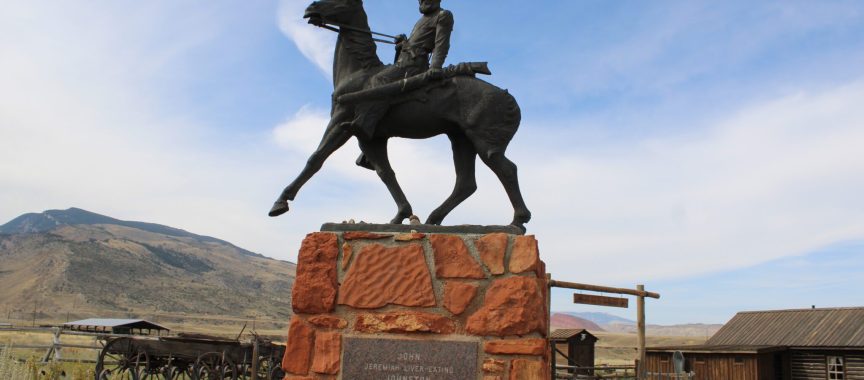
Liver-Eating Johnson died in 1900 in a veteran’s home in California, where he was buried. In the late 1970s, his body was moved to Wyoming, to be buried near the mountains that he loved. Robert Redford attended the ceremony, and Johnson’s grave is in Old Trail Town in Cody.
Photos take at Old Trail Town, Cody

More Like this



Last modified: September 22, 2025