
News – Sheridan Media

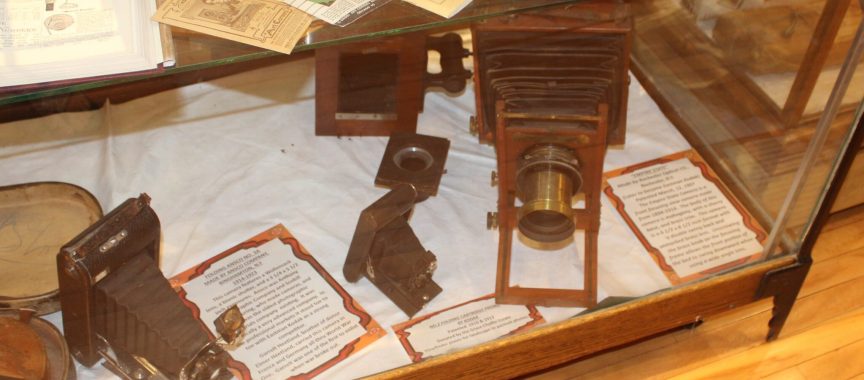
Wyoming’s majestic scenery has been the subject of artists and photographers for many years. Especially the wonders of Yellowstone National Park. Today, nearly everyone has a camera on their cell phones, but the old-time photographs didn’t have it so easy. They carried bulky cameras, and developed their own film, a lengthy process back then.

On display at Trail End Historic Site. Vannoy photo
Probably the first photographer to record the scenery in Yellowstone, and much of Wyoming, was William Henry Jackson. He was a member of the Hayden Geographical Expedition into Yellowstone in 1871.
The South Pass News, September 13, 1870 – U.S. Geological Expedition. Prof. F.V. Hayden, U.S. Geologist, and party arrived in this vicinity Thursday, and encamped for a few days. The following is a list of the members of his party. Prof. F.V. Hayden, U.S. Geologist. Mr.. James Stevenson, First assist antami general manager, Mr. Henry W. Elliott, Artist. Pro C. Thomas, Naturalist. John A. Beamon, Meteorologist. W. H. Jackson, Photographer. Henry D. Schmidt, Ornithologist. A.L. Ford, Metallurgist. Mr. S.H. Grifford, landscape artist. Prof. Hayden started out from Cheyenne; Aug.7th, moving “north ward along the east flank of the Black Hills, he struck the North Platte at Fort Fetterman.

Ad about Jackson’s Photographs in the Cheyenne Daily Sun, August 3, 1894
During this part of his journey, he made a thorough examination of the geological features of the eastern slope of these mountains, extending his side trips as far as Laramie Peak. From Fetterman he moved up the North Platte by way of old Fort Casper, crossing near the ruins of the Platte Bridge, stopping for a day in the vicinity of the Red Buttes. Leaving the Platte at this point he traveled across the Sweet water, striking his latter at “Independence Rock,” where he stopped for another day to make a thorough examination of the granite ridges of that region.
Moving up the Sweetwater he reached here Sept. 1, without accident or injury, every thing having been brought through safely under the skillful management of Mr. Stevenson, who has accompanied Prof. Hayden, for the last fifteen years, in his western geological explorations, and who besides thoroughly understanding the management of such an expedition is the most assidous collector. Prof. Hayden, in addition to his own thorough personal examination of the geology of the entire section over which he passed, and the voluminous notes he has made of all items of scientific and economic interest, has caused sketches and photographs of all important points and places of interest to be made, which will assist very materially in illustrating the opportunities of the Rocky Mountains.

Vannoy Photo
One famous early photographer was mentioned in the Daily Boomerang, December 19, 1896 – At Mammoth Hot Spring, In Yellowstone Park, there is a fence made of elk horns. It encloses the greater part of the grounds of Photographer F. Jay Haynes studio.
The fence is composed of over 800 selected elk horns. All of them have 13 points, and a great many have the royal 14 points. They were shed and gathered in March,1895, and were gathered in June of the same year by Mr. Haynes and three of his men within a radius of ten mile of Mammoth Hot Springs and within four days’ time. There are about 9,600 elk in the park now. Each pair of horns would bring $7.60 at the railroad at Cinnabar, about eight miles, or at least $10 a pair in the east and south – Kansas City Star
In the Uinta Chieftain, December 27, 1884, Mr. Haynes is also mentioned in conjunction with the Wyoming Exhibit at the Worlds Exposition at New Orleans. Haynes was in charge of the art display there.

Vannoy Photo
Closer to home, there were two photographers who wanted to tell the story of the Native American’s in the area. One was successful, the other, well, not so much.
The unfortunate one was Ridgeway Glover, who, in 1865, came West as a Smithsonian Institution photographer to photograph the Ft. Laramie Peace Commission of 1866. He later accompanied Gen. Carrington to the new Fort Phil Kearny, near what is now Story.
In the talk on the Fort Phil Kearny Cemetery, Sept 3, Site Superintendent Shari Shada said that one of the bodies that was buried in the cemetery at one time was Glover’s.
At the Full Moon Fort on Oct. 3, the ‘guide’ told the real story about Glover’s death.
Currently at Fort Phil Kearny, one of the traveling exhibits which will be at fort until Oct. 31, is titled “Through the Lens: Richard Throssel.” Throssel who took photographs of the people and ceremonies on the Crow Reservation from 1902 to 1911.

Display at Fort Phil Kearny Vannoy photo
There were several ads for Throssel’s prints in the old newspapers. Here are some samples.

The Sheridan Post, December 14, 1919

The Sheridan Enterprise, April 3, 1913
Throssel worked with Edward Curtis, a photographer known for taking photographs of American Indians, including Red Cloud.
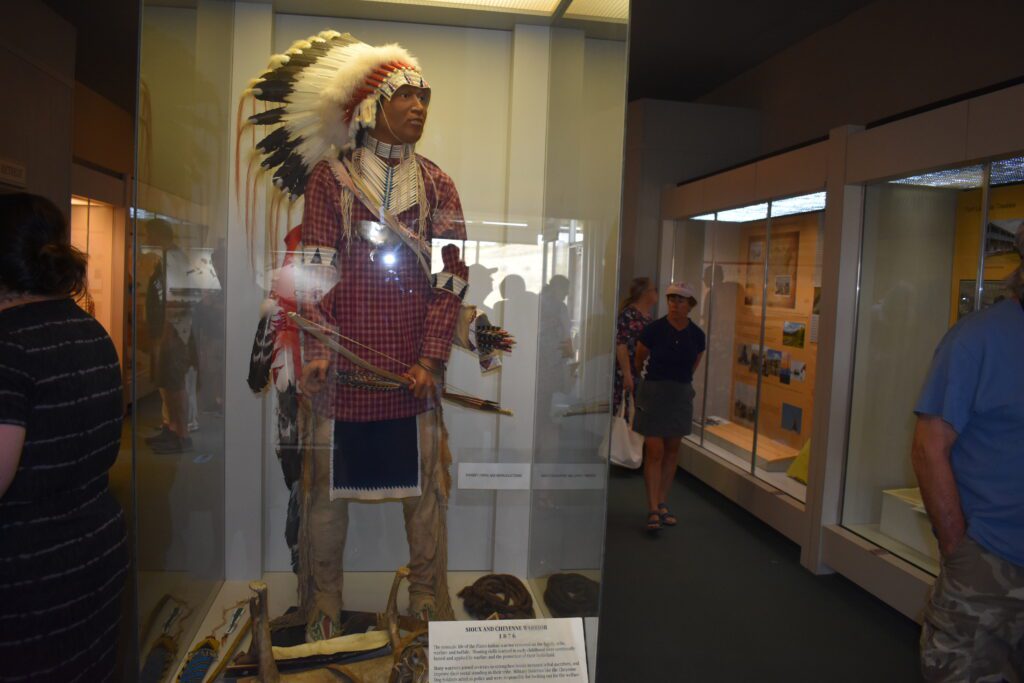
Display at Custer Battlefield Museum Vannoy Photo
These men must be heralded for their dedication to their craft, and we are fortunate that they recorded the West as it was, to give us snapshots into history.
Feature photo taken in the Crook County Museum, Sundance, Wyoming. Vannoy Photo

More Like this


Last modified: October 13, 2025