
News – Sheridan Media
[[{“value”:”
With all the wind lately in the Sheridan area, well, all over Wyoming, many people might wish they had the old windmill again for pumping livestock water, as has been done for centuries. Holland is well known for its wooden windmills, and in Wyoming’s early days windmills were and important part of homesteads and ranch life. They were used for irrigation, water for the home, and to water livestock. This column will look at windmills.
Laramie Boomerang, Laramie. Tuesday. May 22, 1894 – Wyoming’s Power. It is The Wind. – The estimated average speed of the wind throughout the United States is 7 miles per hour, but inWyoming it is just about double this. The Inventive Age says that experiments now going on make the prediction natural that within the next five years the “bonanza farmer,” as the western wheat grower is called, will, with nature’s help, husband electricity by the use of windmills, when the wind blows, instorage batteries to be applied in the propelling of all manner of farm machinery.
The simple touch of a button and the sulky plow will glide across the field turning over the soil in regular furrow: the harrow, the seeder, and later the harvester; then the thresher, and finally the farm wagon laden with wheat, bound for market — all propelled by electricity, generated by inexpensive and, on the western prairies, ever active windmills.
Years ago some homesteaders had these wind towers to generate electricity, and the large storage batteries to store it when the wind wasn’t blowing.
Here is a little about the history of the windmill. Windmills have a long history worldwide.
Lusk, Herald Lusk,Wyoming, September 13, 1894 –Wind Motors. The windmill, according to Mr. Sidney H. Hollands, can boast of a very respectable antiquity, having been described by Herio, of Alexandria about 150 B.C. and being mentioned frequently in Roman History and is in medieval continental records.
It was introduced into England from the Netherlands—where about 12,000 windmills of an average of eight-horsepower each, are still at work in pumping and drawing — at the end of the twelfth century.
The old Dutch mill consisted of four sails of rough frames permanently covered with canvass. To provide for making the sails face the wind, the earliest windmills were floated in water, and later ones — still to be seen in southern England—were mounted on pivot posts, the apparatus being turned by hand in both cases. The automatic fan mechanism was not applied until early in the present century. An automatic reefing and feathering gear for canvass sails was introduced in 1772 and improved in 1804, but since that time the stilts of narrow wooden slats —made to open or close with varying wind-pressure — have come into general use in the English type of windmill, as used to drive a pair of millstones, averages about 12 brake horse power.
In the American type of wind motor, now prevailing in the United States and Canada and coming into use in England and the Colonies, the sail surface is a broad ring, formed of radial slats— perhaps 5O—each of which is a small sail in itself. A simple rudder brings the wheel into the wind, and provides the automatic regulation by moving the whole disk out of the wind as the pressure increases. It was estimated in 1885 that several hundred thousand of these annular windmills were in use in the United States, doing useful work at an average total expense of 5 cents per horse power hour. A third type of wind motor seldom used and less, efficient than the others but a subject of recent study, is the horizontal wind wheel. The electric light plant of the Scotch village of Marykirk is operated by wind power, and the three-ton ship City of Ragusa some years ago crossed the Atlantic under the action of wind driven propellers. A constant wind of at least ten miles an hour, it is believed, would practically supplant steam on land.
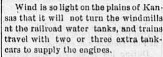
Of course, sometimes the wind doesn’t blow, as we see in this clip

Laramie Weekly Sentinel, November 8, 1879
Windmills were seen as a way to bring life to desert lands.

Cheyenne Weekly Leader, December 23, 1880
The from The Pine Bluffs Post, January 3, 1913 – The records of wind movement show a considerable difference in the amount of wind in different, months, but the wind for any month is approximately the same on succeeding years. In any locality, therefore, the experience of one or two years will enable an observant rancher how much ground it is safe to plant. Wherever windmills are much used, it is customary to build reservoirs nearby for house service and cattle watering they serve to provide storage to provide for periods of calm weather. For irrigation uses they’re too small to be of importance as storage, but they serve as accumulators of water, perhaps for several days, and when they are filled the water can be drawn out and applied to the fields in a few hours.
Thus, they save the irrigator’s time, and they secure an irrigating “head” which can be gotten over the ground as desired. It is not desirable to build large reservoirs, as the loss by evaporation and seepage is then of greater moment than the gain in other directions.
Fortunately the months of greatest wind movement are the spring and early summer months, which include the best growing season. In order to take advantage of the high winds of early spring, the garden irrigator should borrow from the dry farmer the method of water storage in the soil.
During the season before seed is planted, heavy irrigations can be given, preferably in deep furrows, and after each division of the garden is thus treated, the furrows should be covered by cultivation to prevent the escape of the moisture. If the soil is loamy and deep and retentive, fifteen to twenty inches depth of water can be advantageously stored in this way. If the soil is shallow and underlain by porous gravels, such irrigations are a waste of time and water.
There are two conditions in which windmills are especially adapted for irrigation pumping. First, for the house and garden lot, where no other pumping plant is available and where the depth to groundwater is not excessive. Very often the windmill is required for house service, and since that service does not work the mill to more than a fraction of its capacity, it can be utilized the rest of the time watering a garden or an alfalfa patch for poultry with no additional investment. In one instance on record a windmill lifting water ninety feet furnished the water supply for a house and for irrigating eighty-seven orchard trees and thirty-two other miscellaneous plants.

Wooden Windmill at the Rock Pile Museum in Gillette. Vannoy photo.
The second condition in which the windmill is adapted for irrigation service is to provide a supplementary water supply to help out dry-farmed crops. There are large areas in Arizona where dry farming, unaided is almost, though not quite, successful, provided judicious selection of crops is made. The experiments of this station have shown that in such cases a small amount of supplementary irrigation increases the yield out of proportion to the small amount of water applied, even so small an amount as three- or four-inches depth making the difference between crop failure and profit. Over a considerable area which promises to be utilized in the manner the valley fill is of such a character that it is impossible to develop a well at one place which yields sufficient water for a centrifugal pump, yet the slow constant draught of a windmill pump can resupplied.
Both conditions presuppose that the prevailing winds are strong. If the windmill is used to irrigate garden crops such as tomatoes, which need irrigation every few days, it is desirable to purchase a small gasoline engine of one or two horsepower and connect it to the pump rods by belt or gearing. It is then available for use when the wind does not blow.
Then, after WWI, the industrialization of the United States stepped into high gear. Natural methods were being replaced by fuel driven motors for nearly everything.

Rock Springs Rocket, June 25, 1920 – Gasoline Turns the Earth; Motors are Replacing Gondolas in Venice, and Even the Windmills in Holland Disappear. Motorboats in Venice, replacing the gondolas are not the only mechanical profanation that is coming into disappoint future American travelers in Europe. A letter from Amsterdam tells us that the Dutch windmills are being replaced by mills operated by steam and electric power.
Every year some of the old windmills are burned, and they are not re-erected. Time may come when a few windmills will be treasured as relics in Holland; Just as similar structures are still preserved on Aquidneck and Nantucket Island for their curious interest, says the Boston Transcript.
Already windmills of American construction, with steel fans arranged in wheels. Instead of the picturesque old wooden arms, and begun to make their appearance, even in Holland. The metallic windmill with the revolving wheel, is more picturesque than the ordinary steam or water power mill, but it is not so picturesque as the old wooden affairs. On our western prairies and plains the tall windmills, with their big metal wheels spinning high In the air, are indeed a fine feature In the monotonous landscape, but even they are in danger of yielding to the process of pumping water by means of gasoline motors.
The power of the wind, to be sure, costs nothing, while that of the gasoline motor may cost a good deal, but there are times when no wind blows, and the householder tires of waiting for it to rise. Less and less, we are content to attend upon forces of nature. The beautiful sails are vanishing from the seas, to be replaced by belching smoke stacks. On land windmills give place to structures operated by steam and electricity. The stalwart oxen are no longer seen at the farmer’s plow; It is gasoline that turns the earth now. Homeward the unweary motor barks its way!
It is interesting how sometimes history repeats itself. Now, we again harness the wind, this time to add electricity to the power grid. Will the horse and buggy ever return? I guess we wait and see.
“}]]

More Like this




Last modified: January 19, 2026