
News – Sheridan Media
[[{“value”:”
A familiar landmark in Sheridan is the old Best out West Flour Mill, now the Mill Inn Motel, which stands on the south end of Sheridan at 2161 Coffeen, just off I-90 at Exit 25.
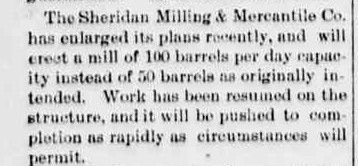
The Best out West Flour mill started in the late 1890s, when Captain Scott K. Snively built a single elevator and a steam powered, wooden milling structure.
The mill was located on 245 Broadway, close to where the Sheridan Commercial Company is now.

The Sheridan Post, April 21, 1892
This from The Sheridan Post, December 17, 1896, about the owner, Scott Snively –Scott K. Snively returned Tuesday from the Black Hills Country where he has been successful in disposing of several carloads of Sheridan flour. The company will ship about eight carloads of flour this month, besides supplying the local demand.
Mr Lowis has shipped several car loads of wheat from the same elevator. Taken although together the Sheridan Milling & Elevator company is doing a good business and is running night and day.

The Sheridan Post July 14, 1892
Bill Barlow’s Budget, Douglas, Wyo. December 16, 1896 – Scott K. Snively, president of the Sheridan Milling & Elevator company, says that for the first time in the history of northern Wyoming wheat commands a price that makes it profitable to ship it out oi the state and as far east as Kansas City, Omaha and St. Louis. He has shipped sixty-seven carloads of wheat the present season and as many more of flour and milled stuff.
In 1895, the Mill is sold to Sheridan Milling and Manufacturing Company. They ran the mill until 1903.

The Sheridan Post, December 17, 1896
This little item was interesting, although it didn’t have to do with the Sheridan Flour Mill. Not sure if the one in Sheridan had a similar belt or not.

The Sheridan Post, October 21, 1897

The Enterprise, December 22, 1900
In 1903, the mill was sold to J.W. Denio and family who modernized and enlarged the mill and were the best-known owners of the Sheridan Flour Mill and owned it the longest.
The Daily Enterprise, October 20, 1911 – The Denio Milling Company, the largest manufacturers of their line in the state, started in business in Sheridan during the season of 1903 and in the eight years they have operated their mills have established an enviable reputation throughout the northwest as manufacturers of high-grade flour and other mill products.
They are also extensive wholesalers of grain; thousands of bushels being bandied annually through their elevators. They also manufacture large quantities of feed.
J. W. Denio. the president of the company, who resides at Longmont, Colorado, has been engaged in the milling business for fifty years. During these years he laid the foundation of the present vast enterprise.
Ralph Denio, general manager, has had personal charge of the mill here since it was established and it has been largely due to his efforts that the business has developed to its present proportions.
In 1903 their milling capacity was 100 barrels daily, with a storage capacity of 15,000 bushels in the elevator and ten cars in the warehouse. Since that time the milling capacity has been increased to 400 barrels daily, and the company now maintains elevators having a capacity of 100,000 bushels, while the warehouse provides room for the storage of fifty cars.
In addition to those in Sheridan the company has elevators at Parkman, Wyo., and Hardin, Mont. The wheat used by the Denio Milling Company is all procured in northern Wyoming and southern Montana, which ranks second to none in the manufacture of flour.
The products of the Denio mills are used as far west as the Pacific coast, while large shipments are made annually to the Black Hills country, to many towns throughout western Nebraska and Colorado.

The Sheridan Post, October 25, 1904

The Sheridan Enterprise, May 12, 1919
Unfortunately, the wooden mill was vulnerable to fire, as we see in this story from the Sheridan Post in 1919.

Sheridan Post Wyoming, Wednesday, July 2, 1919 – Denio Mills and Elevators go up in Flames-Most Disastrous Fire in the History of City – Flames Start in Top of Building and Burns so Fiercely Water Could Not Check it. Buildings and Contents Valued at $250,000 – Origin unknown
Fire which started at midnight completely destroyed the mills and the immense elevators of the Denio Milling company, the largest industrial concern in the city. From every point of view the fire was the most disastrous in the history of Sheridan and the loss will be not less than a quarter of a million dollars. (that is equivalent to around $4 million dollars in today’s money)
Just before twelve o’clock the fire was discovered in the top of the mill, which is the northwest building of the group, and within a very few minutes the whole top of this building was in flames. The fire company responded promptly, and streams of water were soon playing upon the fire, but so great was the volume of the flames that the water seemed to have little effect, and it was soon evident that the plant was doomed.
While there was a fairly good pressure of water, the extreme height of the buildings made it almost impossible to do effective work and the water seemed to have but little effect. The fire constantly gained headway and soon communicated itself to the other buildings. As soon as it became evident that the buildings were doomed, an effort was made to save some of the contents and a hundred willing volunteers began moving office furniture, flour and other moveable property out of the lower floors. The safe, office furniture and books as well as a considerable amount of flour, was taken out, but the amount salvages was small in comparison with the total loss.
Fortunately, there was little wind. The flames shot almost directly upward and illuminated the country for miles around. No alarm was sounded but hundreds of people gathered to witness the awe-inspiring sight.
In spite of the effort of the fire men, one building standing in the rear of the elevator caught fire and was consumed. This was a building in which a large quantity of implements were stored, but practically all of these were saved. It was fortunate that the fire was in the top of the buildings and they were consumed from the top downwards, which made the hazard less for the nearby buildings.
As the Post went to press the fire is burning fiercely, but it is under control and there is no danger of it spreading to other building.
The first of the burned building of the Denio Milling company was built m 1903, and since that time additions have been built every few years. Beginning as a small concern with a milling capacity of 100 barrels of flour daily, it has. grown to be the biggest concern of the kind in Wyoming. Its capacity was 400 barrels of flour each day and an elevator capacity of 200,000 bushels of wheat.
Just at the present time the stock was as low as it has been for years, but still many thousands of dollars’ worth of flour and wheat went up in smoke. The loss, including the buildings and stock, is approximately $250,000 the greater part of which is covered by insurance.
While the origin of the fire is not definitely know, it is believed that it was due to spontaneous combustion. This is the conclusion of the manager Ralph Denio, who was early on the scene.
Although it was impossible the save the mill and elevators, the firemen did heroic and efficient work, and it was only by their almost superhuman efforts that the fire was prevented from spreading and the whole east side of the city wiped out. They stood up against the walls of the burning buildings and continued to play the water, when the spectators had been driven back hundreds of feet by the intense heat.
Although it is yet too early to make definite announcement, it is assured that the plan of the Denio Milling company will be to promptly rebuild. A meeting of the stockholders is called for today, and it is believed that action towards rebuilding will be taken at once.
Lights and Power Off: During the early hours of the fire, it became necessary to cut off the current which supplies the city with light and power. As a result, the linotypes and presses in the office ol the Post could not he operated and it was impossible to go to press in time to make the early train.
The burning buildings stood near the sub-station of the power company and the main wires ran past them. The post carrying the highly charged wires took fire and fearing it would fall and the charged wires electrocute many people, Manager Bibb ordered the current shut off. As soon as the menace disappeared the current was turned on and at 2 o’clock power and light were again available.

Timeline of the Sheridan Flour Mills and the Mill Inn. Thanks to the Mill Inn.
Part two will look into rebuilding the mill at its location on the south side of Sheridan, where it still stands today. Part two will also talk about the history of mill up until 1974, when milling stopped and the building was converted into a 45-unit motel and placed on the National Registry of Historic places. Part two will be posted on Sunday, February 1.
“}]]

More Like this




Last modified: January 26, 2026