
News – Sheridan Media
[[{“value”:”
In the late 1950s, country singer Johnny Horton sang about ‘Snowshoe Thompson,” who carried mail in the Sierra Mountains. The song was based on real-life John Albert Thompson, born Jon Torsteinsson Rue. Thompson was an early resident in the Sierra Nevada mountains in Nevada and California. He is considered to be the father of California skiing.
In the mid-1850s and into the 1870s, he delivered the mail between Placerville, California and Genoa, Nevada. Although his nickname was ‘Snowshoe’ he commonly used skies.
Thompson’s fame even reached as far as Wyoming, as we see in this story from Bill Barlow’s Budget, February 2, 1887 –Snowshoe Thompson’s Great Leap. If not the swiftest, it is universally conceded that even up to the time of his death, Thompson was the most expert snowshoe runner in the Sierra Nevada Mountains. At Silver Mountain, Alpine Co., Cal., in 1870, when he was 43 years of age, he ran a distance of 1,600 feet in twenty-one seconds.
There are many snowshoers in that place, but the daring Thompson passed them all. Near the town was a big mountain, where the people of the place went to assemble on clear days to the number of two or three hundred. The ordinary snowshoers would go part way up the mountain to where there was a bench and then glide down a beaten path. This was too tame for Thompson. He would make a circuit of over a mile and then come out on the top of the mountain. When he appeared on the top he would give one of his wild, high Sierra whoops, poise his balance pole and dart down the face of the mountain at lightning speed, leaping all the terraces from top to bottom, and gliding far out on the level before halting.
But that was snowshoe Thompson of California. Northern Wyoming had their own daring mail carrier, much like Thompson, named Sam Stringer. He did ski and snowshoe as well, but he normally drove a mail stage. Come along for the ride with Sam Stringer and his dedication to delivering mail in the early days of Wyoming.
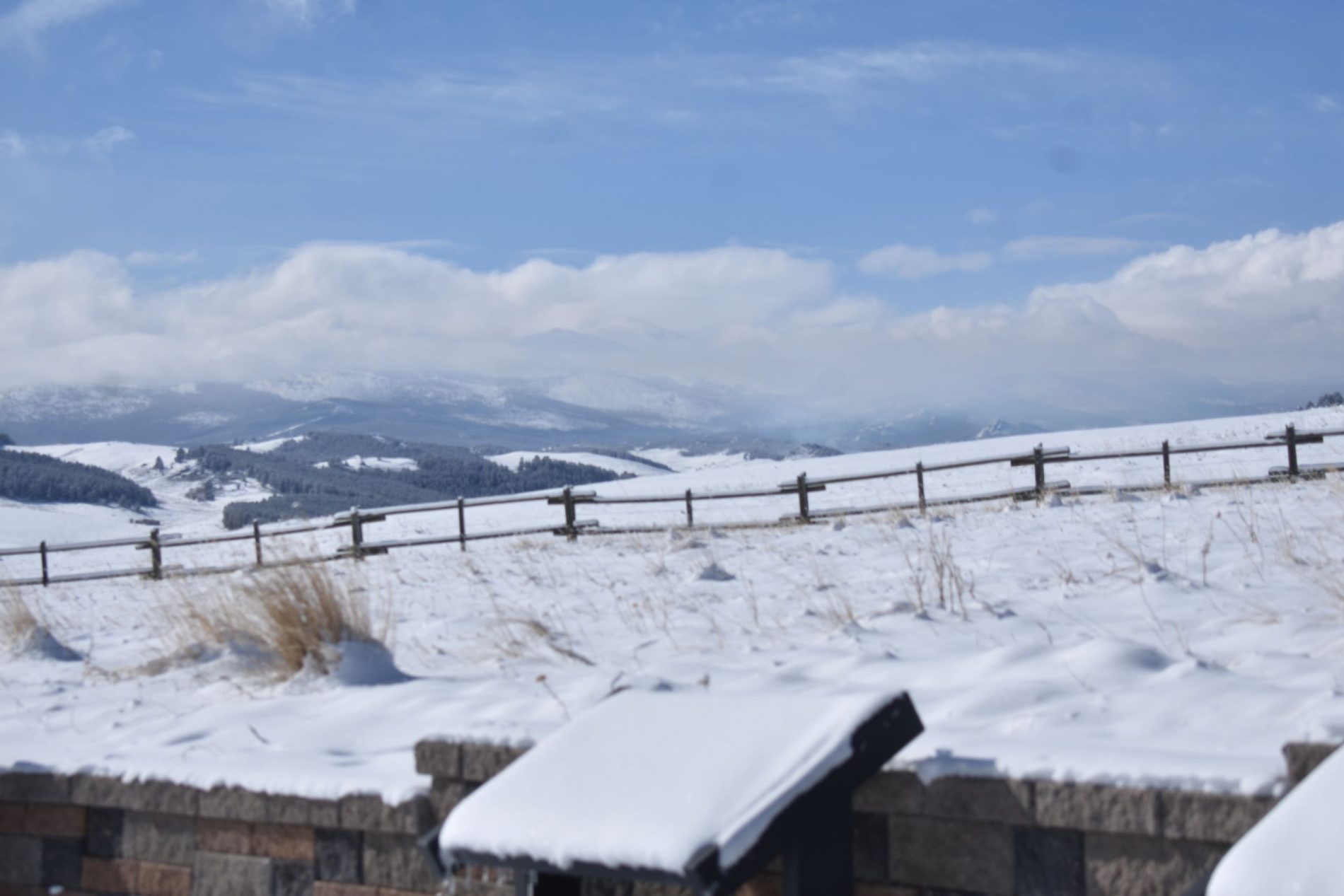
Buffalo Bulletin, April 21. 1892 – Across The Big Horns in Winter. Terrible Sufferings and Miraculous. Escape Of A Mail Carrier. Five Days Crawling on Hands and Knees –Sam Stringer, the veteran mail carrier on mail route No. 14,131, from Buffalo via Oho and Mayoworth to Ten Sleep, started out from this city Monday morning the28th day of March 1892, to attempt for the first time this winter to take mail to Ten Sleep post office across the Big Horn mountains. He reached Mayoworth post office the same evening, started from there on the morning of the 29th with four mules to cross the mountain.
He made about eleven miles, had to leave his wagon about a half mile east of his cabin. He remained in his cabin overnight. On the morning morning of the 30th he tied his mules to the side of the wagon, banked snow on the opposite side for a windbreak, opened a bale of hay and a sack of oats, threw the mail pouch some provisions and an axe on a toboggan, and equipped with snow shoes, started on his journey to cross the vast expanse of snow toward his destination.
Three o’clock p.m. found him on the western slope at a place commonly called the pole patch. when a severe snowstorm overtook him. He lost his way and toward sundown took shelter in a ravine, and there camped. Having no bed, Sam kept fire all night, all the next day, the 31st, and all that night.
On the morning of the first of April, he continued his journey down in this ravine into Little Canon Creek, and down that stream, though timber and brush until night again overlook him.
On the 2nd of April at 11 a.m. he reached Frank Simmons’ cabin on Canon creek, where he took dinner. From there to John Hunsinger is but a short distance. Here he was given a horse to ride the rest of his journey. He arrived at Ten Sleep post office at 1 p.m. Saturday, the 6th of April, six days out from Buffalo.
(Today, along the highway across the mountains Tensleep is 64 miles from Buffalo, and it is about an hours drive.)
Most, men after such a trip, having had no sleep to speak of to speak of for four nights, would have stopped to rest and recuperate, but the hungry mules on top of the mountain urged Sam to face the danger, and worn out and weary as he was, he stopped only long enough to exchange mail, then rode back to Simmons’, changed horses, rode on Simmons horse until the snow became too deep for horseback riding, buckled on his snowshoes and reached the pole patch, when night overtook him.
This was the first horseback exercise Mr. Stringer had for several years, and it brought in him an acute attack of piles. Sunday morning the 3rd he awake stiff, weak and weary, and on that days journey one of his snowshoes became useless, and for five long weary days he crawled on his hands and knees, covering twelve miles to his cabin, where he had left left his team the week before.
It was on the morning of the 7th of April at 3 o’clock when Mr. Stringer reached his cabin again. In this terrible crawling he frosted his hands. feet and legs. He there found that someone had been at the cabin, and had also also liberated his starving mules.
(One must remember that in the 1800s there was no way to communicate with your neighbors. Phones didn’t come into rural Wyoming until the early 1900s. He couldn’t call his neighbor for help)
W. W. Morgeridge, A. L. Brock and two others had been at his cabin the day before, searching for him, had freed the mules and gone to Buffalo to report his probable death. On the evening of the9th the Masons of this city held an informal meeting and decided to send W. W. Morgeridge and a party to search for Mr. Stringer, but within an hour the news of the invasion of this county by armed cattlemen reached the city and Mr. Stringer was left to his fate.
Mr. Stringer remained in his cabin until the morning of the 12th. Replaced his broken snow shoe with an old one he found in his cabin and again started out to reach Powder river.
He had provisions enough for but one meal. Stopped on a bare spot beside a large boulder, eats his last meal when his mules came to him.
Mr. Stringer took off hissnow-shoes, made a halter out of the shoe ropes caught one mule and led him along, the rest following. He led his mulesthrough several snow drifts, and whenever he reached a bare spotthe loose mules looseto graze. He attempted to drive them but weakness compelled him to give it up and he left the mules on a bare spot, where they had sufficient grass to keep them alive. Again, crawling on his hands and knees he got to the timber and another furious blizzard kept him there 36 hours without bedding or food. The next morning dawned clear and bright, and sick in body and at heart, weary suffering and faint from hunger he arrived at Clarksons Canon ranch on Powder River on Thursday the 16th. Kind hands awaited him and tenderly he has been cared for even since. He was brought to Buffalo last Sunday and already talks of his next trip across the mountains as soon as his strength returns and his feet get well.
They were pretty tough back in those days.
This story also tells about his experience. The Saratoga Sun, May 5, 1892 – Mail Carrier’s Experience. The experience of Sam Stringer. a mail carrier who carries the mail from Buffalo to Ten Sleep, across the Big Horn mountains, is something long to be remembered by that veteran himself and adds another tale of hardship endured on the frontier. The perilous journey amid snow storms and blizzards required twenty days time. After going eleven miles he was compelled to abandon bis team and wagon. Buckling on his snow shoes he continued on his journey in this manner, camping wherever night overtook him without bed and scarcely any food. Upon arriving at Ten Sleep he exchanged mails and urged by the thoughts of his hungry team on the top of the mountains, he bravely faced the dangers of the return trip. His experience on this trip was really worse than he had met on starting out. Breaking one of his snowshoes, he was obliged to make his way on foot. He finally got to a ranch on Powder river, having his hands, feet and legs badly frozen. He was taken from there to Buffalo and tenderly cared for by friends. He started on his trip March 28 and returned to Buffalo April 10, having been at the mercy of the storms for twenty days.
Problems even happened in the summer to delay the mail delivery.
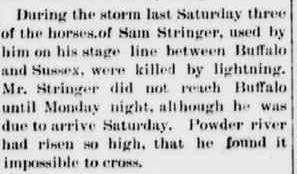
The Sheridan Post, June 17, 1897
In his obituary from the Sheridan Enterprise on September 23, 1905, it talks about Stringer’s work with the army at Fort Phil Kearny before he became a mail carrier.
Noted Pioneer Dead – Sam Stringer passes away after an eventful Death brought an end to a notable life when Sam Stringer passed away at the state hospital Sunday afternoon at the age of 74 years. Mr. Stringer, before the war was a teamster in the employ of the government at a Texas fort. When the war broke out he followed the commanding officers and troops, who joined the Confederacy. Before the war was over he came north and again became a teamster at Fort Leavenworth, on the union side. He served In all the posts along the line from Leavenworth, including old Fort Kearney in Nebraska, Fort Laramie and Fort Bridger.
In 1866 he was assigned to Gen. Carrington’s command in the expedition that built Forts Reno. Phil Kearney, and C. F. Smith on the old Bozeman road. During the latter part of that year he was located at Fort Phil Kearney. When the Indian fight that is known as the Fetterman massacre occurred on December 21, he was ordered to the battlefield with his teams to bring in the dead a few hours after the deed was done.
The massacre occurred along about noon and about 8 o’clock in the evening he returned, bringing in the bodies of Capt. Fetterman and Capt. Brown in his own wagon. When he obeyed the order of his officers he said he never expected to get back alive as he thought the Indians would get the balance of the command.
After remaining in the service for several years, he resigned and ever since has been interested in mail and stage contract in this section. He never tired of telling of the advantages of Northern Wyoming over every other place. He took part in all the Indian wars, in Wyoming, tie joined the Masons in the early days while located at Fort D. A. Russell at Cheyenne. The funeral was held under the auspices of the Masons in Sheridan and interment was made in the Mount Hope Cemetery.
One has to admire these old-timers who risked their lives on the Wyoming Frontier.
(Editors note: Thank you to Judy Slack, Big Horn Historical Society, who published a story about Stringer in her newsletter and giving me the idea to dig deeper. Thanks.)
Feature photo: Snowshoes on display at the Nici Self Historical Museum in Centennial, Wyoming. (Vannoy photo)
“}]]

More Like this

Last modified: February 16, 2026