
News – Sheridan Media

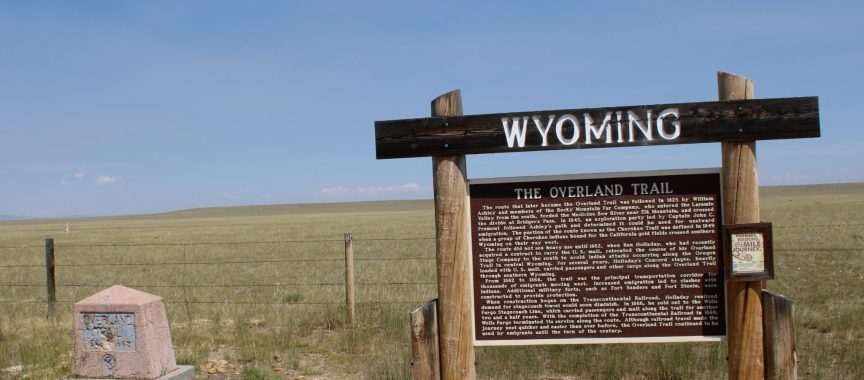
Although the Overland Trail and the Overland Stage Line ran through Southern Wyoming, it was instrumental in bringing more people into the territory. Trails and stage lines branched off from the Overland Trail, bringing emigrants into all corners of the state.
It also introduced a wealth of interesting characters that are a part of the fabric of Wyoming history. Here is some of the story of the Overland Trail and the Overland Stage Company.

Taken at the Wyoming State Museum, Cheyenne, Wyoming. (Vannoy photo)
The Laramie Daily Boomerang, January 4, 1911.
One of the subjects most interesting to the people of Albany county and Wyoming today is the old Overland Trail. Some months ago-the Laramie Literary club held a meeting and discussed marking the trail through this county. Maps were-hung there and old timers called upon to give any information they could concerning the location of the trail and the incidents that happened along its course.
A committee was appointed to start the movement for marking the trail. Various societies and all the schools of the county were called upon to give or contribute towards markers.
The D.A.R. offered to give one and will meet shortly to decide what sort of marker it will be and where it will be placed.

Marker on Snowy Range Road near Laramie
For a time the Overland Trail followed the route that many gold miners and emigrant had followed years before, dubbed “The Oregon Trail.” Later, the route was changed to accommodate the faster, lighter stagecoaches to carry passengers and mail. It was also the route of the pony express…..
The Laramie Boomerang – By 1851 so many people had gone west that a mail line became a necessity. Therefore,John M. Hockaday and William Liggettestablished a stage-line to carry mail and passengers The time required by the government contract was twenty-one days from St. Joseph, Mo., to Salt Lake. Utah. Horses were used and were changed at Fort Kearney, Fort Laramie, Port Hall and Salt Lake. This line was in continuous use until 1858, when Russell, Majors and Waddell purchased it. The route was changed so as to run from Atchison, Kansas, to Salt Lake, having stations, built every ten or fifteen miles, at which the horses were changed. Besides the horses, Kentucky mules were used to draw the large Concord stages. The stage covered the required distance of twelve hundred miles in ten days.

Area around where the Overland Trail once was near Laramie
Besides the stage-line, another great improvement was made along the Emigrant trail.
This was the Overland telegraph line, constructed along the Overland trail in 1861. The telegraph stations along the trail in Wyoming were at Fort Laramie, at Horse Shoe Creek, (this station was the one that John “Portugee” Phillips stopped at the during his legendary 235-mile ride in December of 1866 through a blizzard. Phillips rode from Fort Phil Kearny to Fort Laramie to telegraph the military that troops were surrounded by hostile warriors and needed additional soldiers.) Deer Creek, Platte Bridge, two on the Sweetwater, one at South Pass, Sand Creek, Fort Bridger, and a few other places.

Info at a rest area in Colorado
This same year witnessed many cruelties committed by, the Indians. The leading tribes on the warpath were the Sioux, Cheyennes, Arapahoes and Shoshones. In one of the fights the eldest son of Chief Washakie was slain. These Indian troubles were continued in 1862.
In fact, the emigrants, freighters and Overland mail coaches were harassed until the U.S. volunteers were sent out to the frontier to fight the Indians. About this time Ben Holliday became proprietor of the stage line. He immediately supplied the line with more men, horses and provisions.
Just as the line was ready for operation, the Shoshone tribe swooped down on the stage stations from the Platte River, just above Casper, down to the Bear River station, in the southwest corner of Uinta county. These plunderers took all of the horses belonging to the stage company, and left the stages standing out on the prairies, with the passengers inside, unharmed.
On this raid the Indians killed only one person. This was the cook at Split Rock station on the Sweetwater. This cook was a negro who had come from Pennsylvania and who spoke only Pennsylvania Dutch. When the Indians asked, in fairly good English for something to eat, the poor cook could not understand. Thoroughly terrified, the cook stood before the Indians while they tried French and Spanish. But the poor fellow, failing to understand, was killed immediately.
Besides taking horses, the Indians cut down the telegraph line from time to time. Soon after this the government sent troops, which were stationed in small groups along the trail. For some time after this there was peace among the Indians. However, already mounds were scattered along the trail with such inscriptions as: “Patrick Moran of Missouri, was killed by Indians on the 18th of July, 1860”
Now, in 1862, a great change was made on the Overland stage route. It seems that the citizens of Denver had induced Ben Holliday to promise that he would discontinue the route through South Pass and would run the line through Denver. Accordingly, in the summer of this year, the line was transferred.
The trail at this time went from Omaha to Sidney. About forty miles south of Cheyenne the road branched, one branch going to Denver, the other coming up the Cache la Poudre to Cheyenne, up Dale Creek to the Dale Creek ranch or “Home Station, from there up to Virginia Dale, then to”Dirty Woman,” thence two miles north to Tie Siding, up Willow Creek, through the Black Hills, (One mountain range near Laramie used to be called the Black Hills) across the Laramie River (near the present site of the tie plant at Laramie), out to the stage station at the Hutton ranch, from there across the Laramie Plains to the stage station at Mandel, on the Little Laramie River.
West from Mandel the trail led across Rock Creek to Elk Mountain, past the military post of Fort Halleck, (near Elk Mountain) down over the range to the Platte River, about twenty miles south of Fort Steele to Pine Grove, then across the Rocky Mountains proper to Bitter Creek, past Rock Springs, then across Green River, past Fort Bridger, and on out of the state.
Another description of the trail traces the route thus: From Denver the trail led past the stage stations at Big Thompson, La Porte, Virginia Dale, Big Laramie, Cooper’s Creek, Medicine Bow, Elk Mountain, North Platte, Sulphur Springs, Laclede, Rock Springs, Green River, Granger. Fort Bridger, Bear River, Echo Canyon, Salt Lake.

Site of Virginia Dale Stage Station

The equipment under this management along the line was greatly improved. The large Concord stages were, still in use. These coaches held about fifteen passengers. The horses used were well fed and well-groomed and generally in the best condition The horses were changed at the stations called “swing stations.” Besides the blacksmith shops at these stations there were traveling blacksmiths, who went along the line repairing and shoeing.
The stages usually used four horses, but in hard wheeling, when the roads were sandy, they used six horses. Although the horses were changed, the coaches went the entire route without change. The stage drivers drove about fifty miles and then changed. One of the stage divers across the Laramie Plains in ‘68 was Thomas Dayton, pioneer of Laramie, who, when a young boy, crossed the plains with his father before the stage line was established.(Buffalo Bill Cody, at one time, also drove for the Overland Stage Company)
From two sources I have heard about Jack Slade, the division superintendent of the Overland Stage Company. His headquarters were at the Dale Creek ranch, or “Home Station.” Slade was a regular ruffian, according to my authorities. Few passengers went over the stage line in the early sixties without meeting or hearing of Slade. This desperado was hung at Virginia City, Mont., in 1863.
This is a two-part story. The history of the Overland and the Overland Stage Coaches is nearly as long as the trail its self. There will be more about the Overland next week.

More Like this


Last modified: July 14, 2025