
News – Sheridan Media
[[{“value”:”
In April of 1905, Sheridan received funding from Andrew Carnegie to build a new, modern library. It was one of 16 libraries in the state of Wyoming to receive such funding. In this history column we will look at the steps Sheridan took to build their library, and brief look at Andrew Carnegie and his philanthropy.
The Sheridan Post, April 15, 1904 –Site for Library – One Proposed on Loucks and Brooks St. is Considered an Ideal Location. Andrew Carnegie has volunteered to send the commissioners of Sheridan Count a draft for $12,500 with which to construct a free public library in the town of Sheridan.
Under the state law the commissioners are required to provide for maintenance of public libraries donated to the county, and have passed resolutions signifying their intentions of complying with the law. Now it is up to the people to furnish the site for this Carnegie library. It is a chance to secure a free library which very few towns the size of Sheridan ever have. The executive board of the Sheridan Commercial club, which secured the donation from Mr. Carnegie, has the matter of a site under consideration for the past two weeks, and has settled upon apiece of ground, facing 75 feet on Loucks Street and 99 feet on Brooks street, providing funds can be raised to buy the site.
The club feels that to make the library popular and useful it should be centrally located. Elsewhere in this issue the Post published a letter from a prominent man of Cheyenne, who admonishes Sheridan to not make the mistake Cheyenne, did of placing the library away from the central or business part of town. Messrs. J. W. Loucks and T.B. Freeman, who own the site which is the first choice of the committee, will make the very liberal contribution of $200 and $1100 respectively, and other well-to-do property holders on Loucks and Brooks streets will no doubt do handsomely.
The ladies of Sheridan have volunteered to do what they can to assist in raising funds to apply to the purchase price of the library site, and when fhe women of our city get as enthusiastic as they have in this instance, they always accomplish much. The town has been divided into nine districts, and two ladies have been appointed in each to collect donations of districts, and two ladies have been appointed in each to collect donations of householders, residents, mechanics, laborers, etc.
It has been thought advisable to make a popular subscription of $1.00. No one is too poor to contribute this much, and anyone giving that amount will feel that they have some interest in the library. It is expected that at least 850 people in the town and county will give $1.00 each. This with Messrs. Loucks mid Freeman’s subscriptions will amount to $11,150, leaving $850 to be subscribed by the larger property owners and business men of the town who have the future of Sheridan at heart. The latter will be called upon by the executive board of the Commercial club. During next week the ladies will do their work, and itis hoped that the response will be such that the best site can be bought. Otherwise a less desirable location will of necessity have to be selected.
(the location at Loucks and Brooks was purchased for the new library)
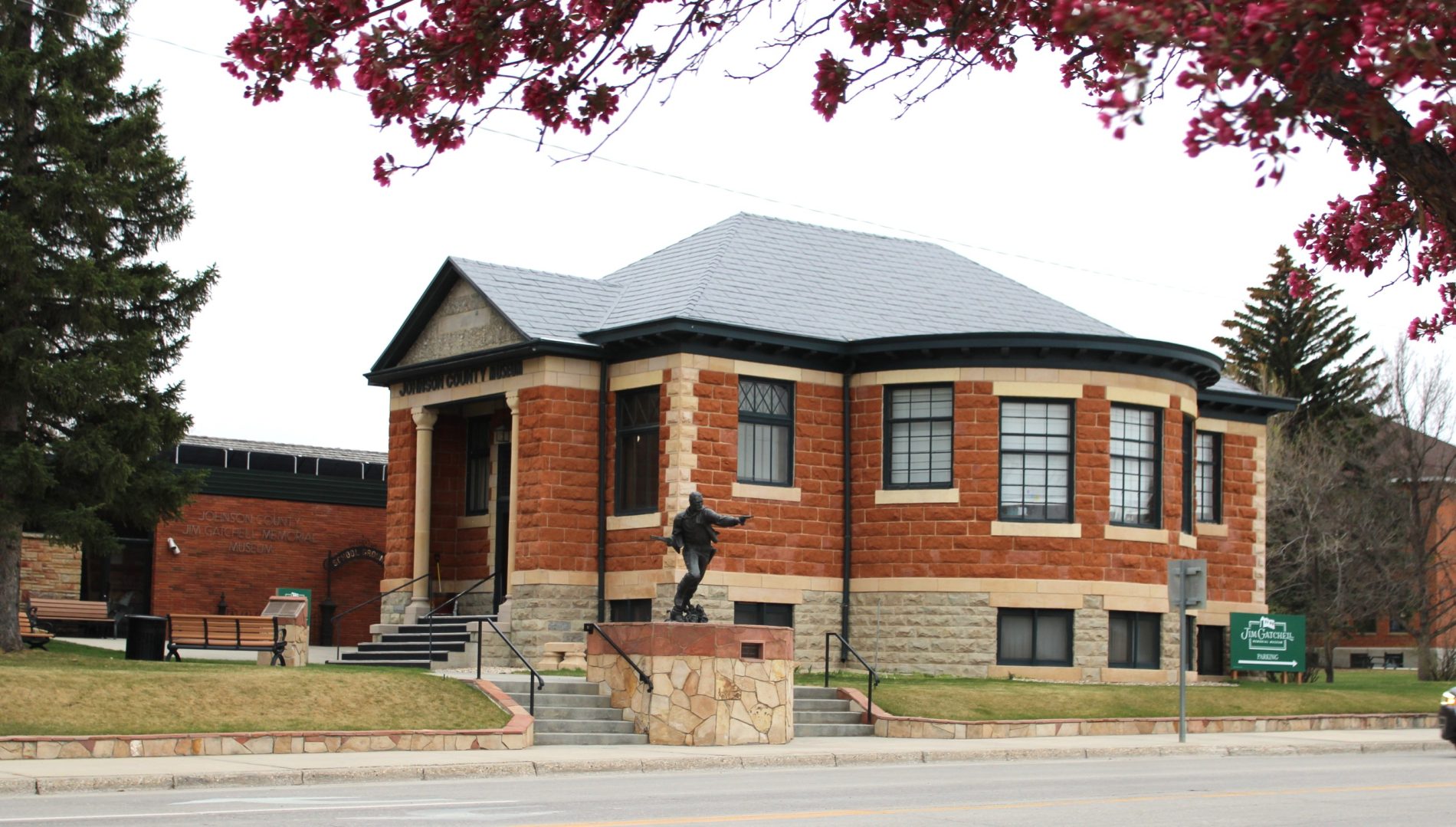
Old Carnegie Building in Buffalo, Wyoming.
Andrew Carnegie, born in 1835 in Scotland in 1835. In 1848, at the age of 12, he came to America with his parents, who settled in what is now Pittsburg, PA. He led the expansion of the American steel industry in the late 19th Century and became one of America’s richest men.
He died on August 11 of 1919, but before he died he gave away millions of dollars to worthy causes, including libraries. The first Carnegie Library opened in 1883 in Dunfermline, Fife, Scotland, where he was born. As seen in the above story about Sheridan’s library, Carnegie would provide the funds to build and furnish the library, but the local authorities had to provide the land, operate and maintain it.
Once the land was acquired, the work began on building the library.
The Sheridan Post, September 6, 1904 – Bids will be received by the undersigned until September 15, 1904, at noon, for the erection and completion of a Carnegie library at Sheridan, Wyoming, according to plans and specifications prepared by J.O. Link and G. McAlister, architects plans on file at the architects’ office. All proposals must be accompanied by a certified check equal to 6 per cent of the bid. checks to retained until successful bidder has furnished good and sufficient bond equal to 50 percent of the contract price. Checks will be returned as soon as proposals are rejected. The board of trustees reserves the right to reject any and all bids, or accept any one bid. T. J. Foster Secy. Board of Trustees
By October of 1905, the library was open for business.
The Sheridan Post, October 20, 1905 – Library Announcement. Hours Which Library is Open to the Public. Invitation to use Library Reading Room. Patrons of the library may receive the application blank to be signed as a guarantee by someone personally known to the librarian, and three days from the time the blank is returned the patron may receive his own library card and may take any book that is now ready for issue. New fiction is being added to the shelves from day today. With the exception of legal holidays, the library will be open from 10 to 12 in the forenoon, from 2 to 6 in the afternoon and from7 until 9 in the evening: on Sundays from 3 p.m. until 9:30 p.m. -By order of Board of Trustees, Carnegie Library.
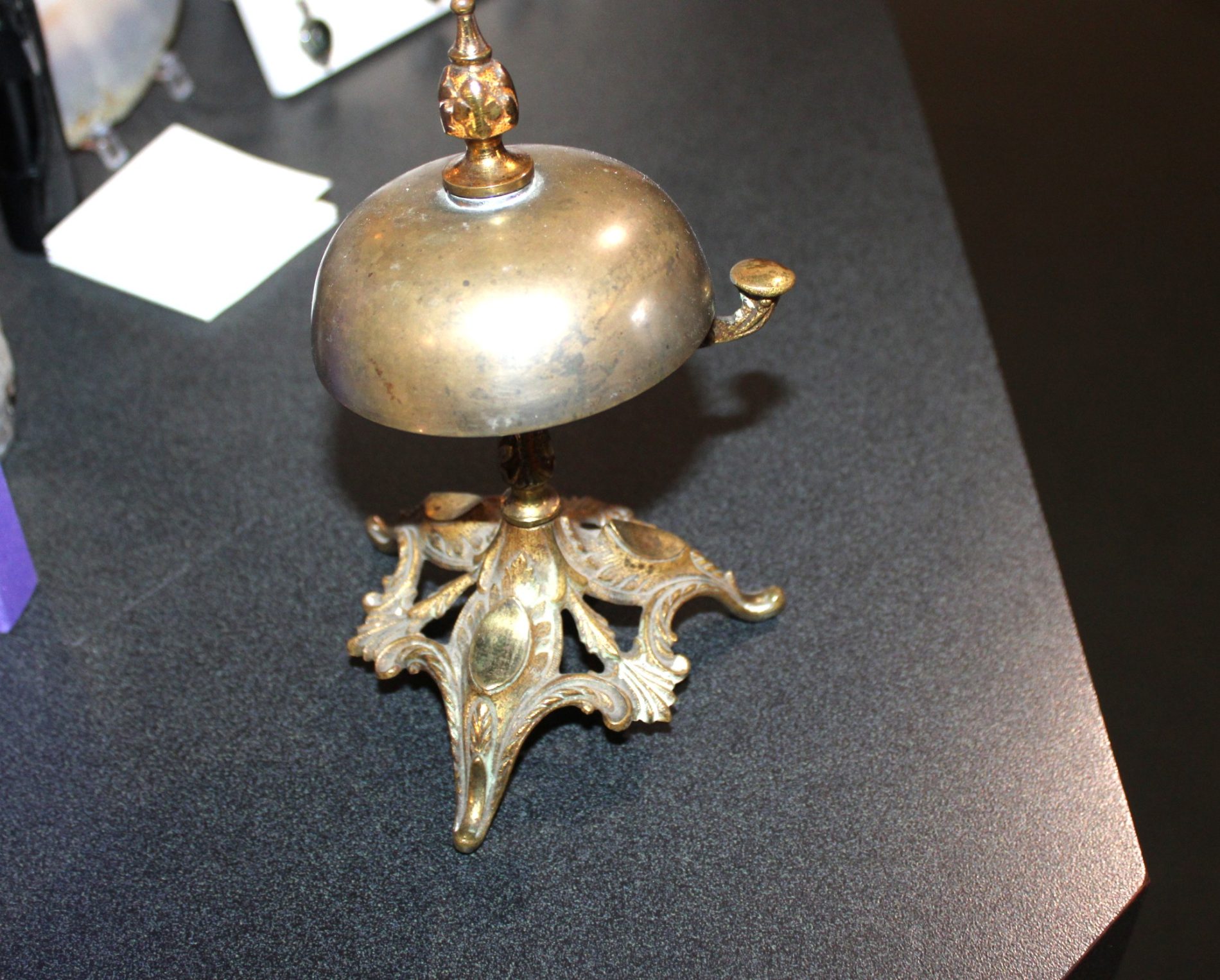
A bell from the Carnegie Library in Buffalo to summon a librarian. On display at the Jim Gatchell Museum.
Carnegie was indeed generous, and many libraries and other buildings, such as Carnegie Hall, were endowed by his generosity. Here is a brief look at the man.
This from the Sheridan Enterprise, August 11, 1919 – Lenox, Mass., Aug. 11. — Andrew Carnegie, 84, steel magnate and philanthropist, died at his summer home at “Shadow Brook,”at 7:10 o’clock this morning, after an illness of less than three days, with bronchial pneumonia. So sudden was his death that his daughter, Mrs. Roswell Miller, was unable to get to her father’s bedside before he died. His wife and private secretary were with him at the end.
Mr. Carnegie spent most of the summer at Lenox, coming late in May and up to a few weeks ago enjoyed himself fishing at Lake Mahkeemac and riding about the grounds.
At the age of 66. he resolved to give away his enormous fortune. He held it “disgraceful” for a man to keep on gathering idle millions. In the comparatively few years which the actuary could allow him, he would disembarrass himself of practically all he had.
No man had ever launched a philanthropic campaign of such dimensions. His was then a fortune of just about a quarter billion dollars, the largest ever acquired by a foreign born American, second only to the John b. Rockefeller wealth as the largest individual accumulation in the United States, and, built, as it was, of five per cent steel bonds, it would, without so much as turning over one’s hand, have approached half a billion by the time Carnegie could call himself an octogenarian on November 25, 1915.
$300,000,000 Are Given Away by Carnegie -To give this stupendous sum away, in about half the time he had taken it, was the purpose Carnegie had! fairly well fulfilled when death overtook him today. He had distributed about $400,000,000. It was giving money away at the rate of over $20,000,000 a year, or more than $60,000 a day. He declared, when he gave up gathering wealth and announced an era of distribution, that he expected to find it more difficult to give his millions away than it had been to acquire them. “How would you give $300,000,000 away?” became such a popular query that an English advertiser who employed it, received no less than 45,000 suggestions of how Carnegie could rid himself of his wealth. Twelve thousand persons solved the problem in part by asking for some of the money for themselves.
$53,000,000 Spent for Founding Libraries –“I have just begun to give money away,” he said in announcement of these gifts. He kept it up as fast as he could with discrimination. On libraries alone he spent upwards of $53,000,000. He gave them to some two thousand English speaking communities throughout the world. One of his libraries is in the Fiji Islands. He remembered Pittsburgh, the scene of his steel-making triumphs, by establishing there a great institute, including the largest of his libraries, a museum, a magnificent concert hall and the Carnegie Technological Schools, with a total endowment of $16,000,000. He built a great national institution in Washington, which should be the fountain head of advanced work in “investigation, research and discovery,” and placed in the hands of its trustees a total endowment of some $20,000,000. To his native Scotland his largest single gift was a fund of $10,000,000 to aid education in Scottish universities. He carried out his pet idea of a hero commission, endowed in 1905 with $5,000,000 by which hundreds of men, women and children have been rewarded with Carnegie medals or pensions for acts of heroism in the rescue of imperiled persons. He later extended similar benefactions to several foreign countries.
His love of music moved him to equip hundreds of churches and institutions with pipe organs. He never gave directly and large sums to religious purposes. Of his organ gifts he said he would hold himself responsible for what the organ pealed forth on the Sabbath, but not for what might be said in the pulpit.
One of his very earliest gifts, as far back as 1891, was the Carnegie Music Hall in New York, at a cost of $2,000,000, an as president of the New York Philharmonic Society he spent his money liberally in furthering its ideals. He also liberally backed the Pittsburgh orchestra.
On a side note, recently a Sheridan High School student, Meredith Walker, played viola at Carnegie Hall.
During the 1970s, Sheridan built a new library, and in 1974, the old Carnegie Library building was demolished.
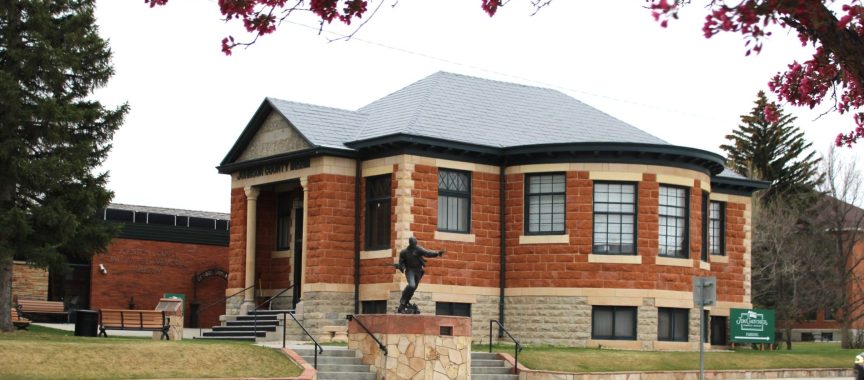
In Wyoming, a total of 16 Libraries were endowed by Carnegie, and ten of the 16 buildings are still standing throughout the state. The feature photo shows the Jim Gatchell Memorial Museum in Buffalo, which is now housed in the old Carnegie Library Building.
Thanks to Carnegie, 122 years ago this month Sheridan began work on a new library.
Feature Photo, Jim Gatchell Memorial Museum, Buffalo, in the old Carnegie Building, build in 1909. Sheridan’s was built in a similar fashion.
“}]]

More Like this




Last modified: April 20, 2026