
News – Sheridan Media
[[{“value”:”
Sheep ranching started in Wyoming in the early 1870s in Southern Wyoming, but they didn’t infiltrate the cattle ranges around the Big Horn Mountains in any great numbers until about 30 year later.
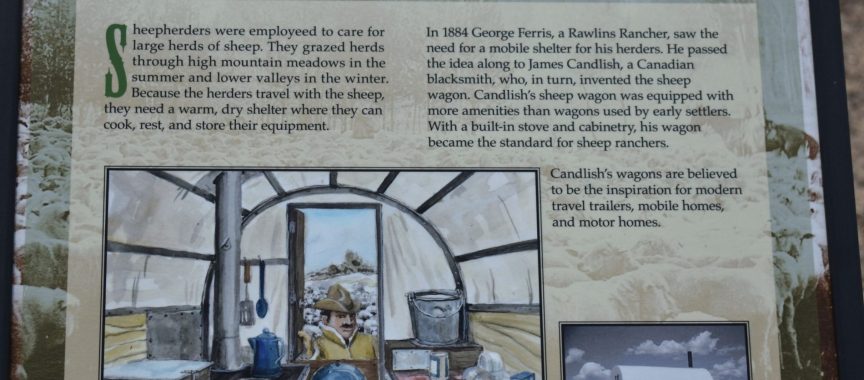
With sheep ranching came sheep herds, and with the herder came the first ‘tiny home on wheels’ or the sheepwagon.
In this column we will look at sheep wagons in Wyoming. One of the first references to a sheep wagon was this story in the Daily Boomerang, in Laramie on January 15, 1892.
This is part of a longer story about the experiences a reporter had in camp with the cowboys.
Every boy expects to be eaten up by a panther or ‘painter,”which is the ordinary mountain lion. The mountain lions were the scavengers of the camp where I lived while away. All the gravy, meat and fried potatoes that were leftover from a meal were thrown out in front of the tent, and every night the mountain lions came prowling around to eat what we had left over. One night I saw one and fired at it three times, but missed, although Brooks held a coal oil lamp to enable me to see the sights on the gun. They are the greatest cowards m the mountains, although people who are not familiar with them believe that they stretch out on limbs of trees and pounce upon unsuspecting travelers….. These lions are the only sneak thieves in the mountains.
I never visited a house there and found locks on the doors. The room where I slept at the Brooks ranch had an outside door, but no lock. Our tents were left day after day, and although we occasionally knew that cowboys had stopped and helped themselves to food, nothing else was taken. I was told that a man had been arraigned for stealing in Natrona County for several years.
I was riding with Brooks one day when we came to a sheep wagon. The herder was gone, but everything was lying about loose. Being hungry, Brooks made a five and we cooked a meal. While we were eating, the herder returned. I expected trouble, but he simply expressed his regret that he had no butter, and aided us to find several things that had escaped us….
Speaking of sheepwagons reminds me that the great talk in that country now concerns the sheep business. There was a time when it was thought necessary for a sheepman to own a ranch and feed the sheep in the winter but it has lately been discovered that the best way is to allow them to drift wherever they will, summer and winter alike, following them with a sheep wagon. These are houses built on wagons, they have a good bed, a good iron stove and are comfortable in all sorts of weather. Some of them are adorned with pictures and kept very clean. The herders live in the wagons all the year, only going to town at shearing time.
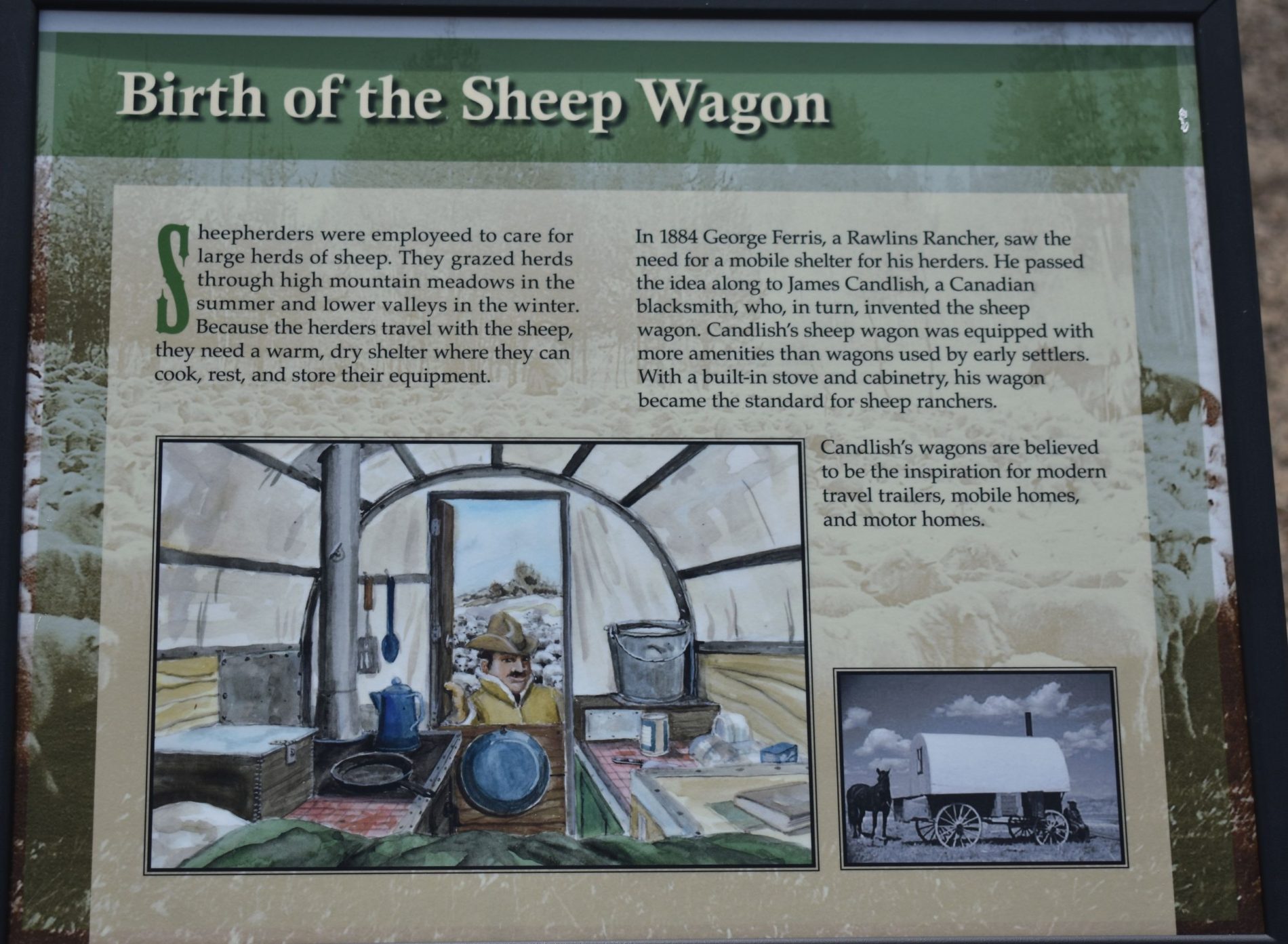
Basin Republican, November 25, 1910

Wind River Mountaineer, December 11, 1895
This from the Wyoming Industrial Journal Laramie, March 1, 1908
Arthur Chapmann interestingly talks about the sheep business. “Naturally the central figure is the sheep herder. He is the man upon whom the owner depends for the safety of an average flock of from 2,000 to 2,500 sheep, which may be worth from $10,000 to $30,000. It has been the custom to look upon the sheep herder as the man who takes up the employment because he is “locoed,”or because he cannot do anything else. Nothing could be further from the truth.
No sheep owner could not put so much responsibility on the shoulders of incompetent or irresponsible men. The herders are selected from the best material the labor market has to offer and are paid from $50 to $75 per month and board. The herder is furnished with everything he needs, and there is no limit to the quantity or quality of his fare. He is given ‘carte blanche’ to order what the market affords, and the “camp tender,” who comes with supplies once or twice a week, sees that the order is promptly filled.
The sheep wagon, in which the herder lives in winter is a veritable house on wheels. It is a canvas covered wagon, containing cookstove, bunk, cupboard and in short everything that can make life bearable for herder. In one of these wagons a man can remain comfortable while the “norther” rages without. In summer, while in the mountains, he lives in a tent, but this is all a man requires among such ideal natural surroundings.
This story was reprinted from the Buffalo Voice about sheep in the Big Horn Mountains.
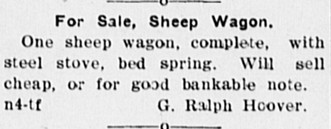
The Wyoming Industrial Journal, August 1, 1900 – “To get an accurate idea of the magnitude of the sheep business on the Big Horn Mountains, in the summer months,” says Enumerator West, “one must go up and see it. There is not an inch of waterfront from the extreme north fork of Bear Trap to the Natrona County line, that has not been filed upon by some sheepman. The sheep along that immense stretch of country are as numerous as the hairs on dog’s back. On almost every pinnacle you may see either a sheep wagon or teepee, indicating the presence of band of sheep.” Mr. West estimates that at least 400,000 sheep are now being grazed on that part of the mountains. —Buffalo Voice.
It wasn’t always easy for the sheepmen to become established in Wyoming. Cattlemen disliked them, felt they ate grass on the open ranges that could be used to raise cattle. There were many violent attacks on sheep herders, and many sheep were killed in the early part of Wyoming’s history.
Sheridan Post Tuesday, Feb. 14, 1911 – Sheep wagon Is Riddled Henry Bund, Herder, Shot Through Shoulder. Horse is Wounded. Waisner’s Wagon Target of Two Man Armed with Automatic Rifles Investigation Begun.
Henry Bund, herder for Waisner Sons, woolgrowers, is in the state hospital with bullet hole through his right shoulder, which he received Sunday night, when two alleged raiders, armed with automatic guns, fired fourteen shots through sheep wagon, in which Bund and Chet Waisner, one of tbe owners, were sleeping. A horse picketed near the wagon was also shot through the ‘shoulder, but most of the bullets passed through the body of the wagon, almost entirely wrecking the cooking utensils and creating havoc among the provisions and other articles which were in the wagon The shooting occurred about o’clock in the evening. Having finished their supper and tired with the day’s work.
Mr. Waisner was lying down and Bund was preparing to go to bed, when, without warning of any kind, the fusillade began. Armed with automatic rifles, the shots came so close together that it is not know whether or not it was the first bullet that struck Bund, but it was near the beginning of the firing that Bund was struck. Mr. Waisner’s escape from injury was due to the fact that he was lying down and was partially protected. Bund dropped to the floor of the wagon as soon as possible, and was struck only once. The shooting occurred In the region known as the Cottonwood, west of and not far from Arvada.
The wagon was at the head of canyon through which the raiders approached. Empty cartridges lying on the ground show where they stood while shooting, and it was about 25 yards from the wagon. Immediately after the firing had ceased the beleaguered men looked out and saw the raiders running down canyon.
They were on foot at the time, but some distance away the tracks show that they had left their horses, which they mounted and rode away. Bund was taken to Arvada, where he received surgical attention, and last night was brought to Sheridan and placed in the hospital. At present he is resting easily, and unless blood poisoning develops, he will probably recover. The shooting was reported to the Sheridan County officers this morning. and Governor Carey was immediately notified. The matter was also taken up with the head officers of the Woolgrowers’ association, and Joe LeFors, detective for the association, was notified. LeFors will arrive on the scene not later than tomorrow, and determined effort to apprehend the raiders will be made.
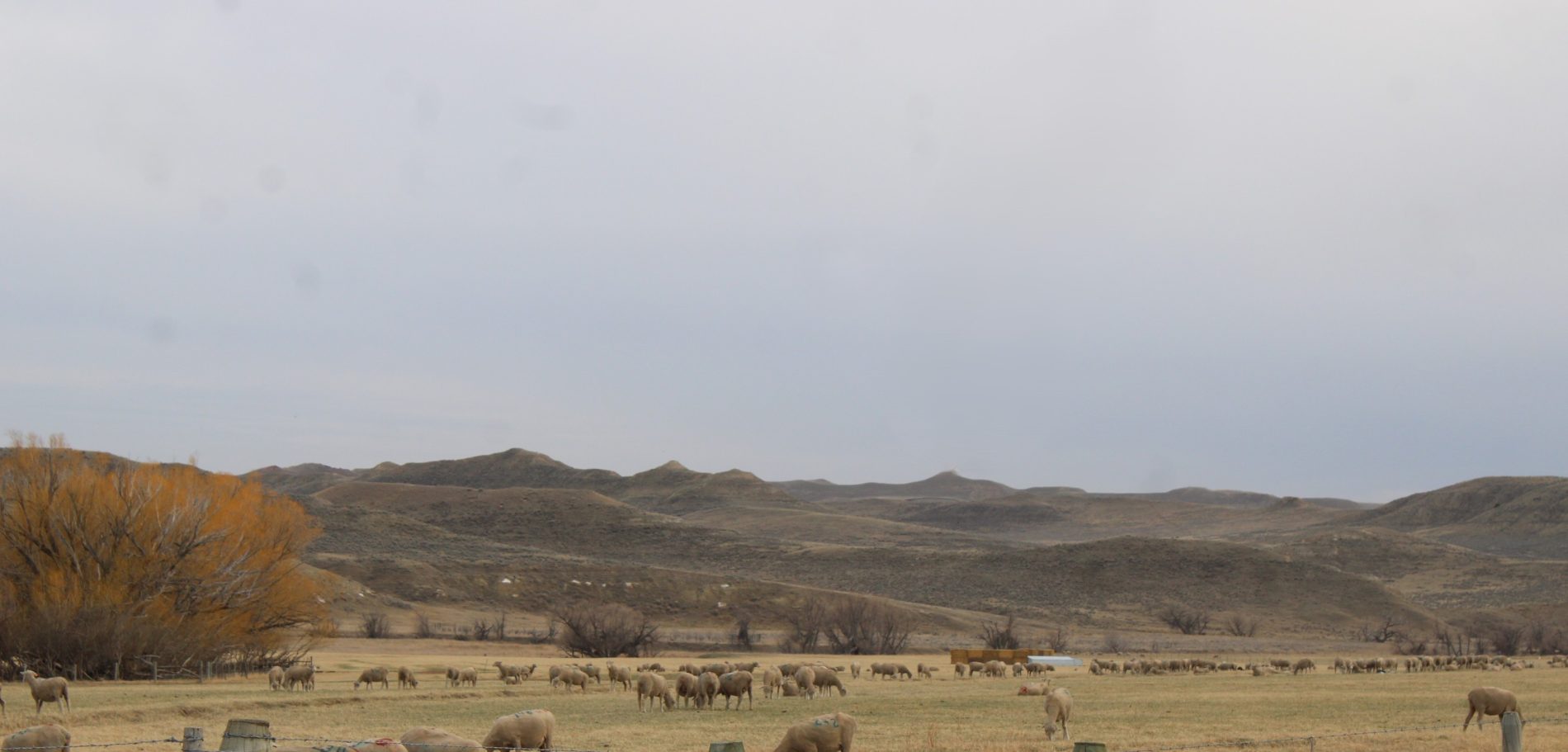
Today, the animosity against the sheepmen is over. Many ranchers in Wyoming run both sheep and cattle. Sheep are a dual purpose investment, producing both wool and meat. Where a cow normally has only one calf a year, sheep commonly have twins, and often even have triplets, thus having more livestock to market.
Sheep wagons are an interesting part of Wyoming’s history and can still be seen around sheep ranches today.
Excepting sheep, photos taken at old Fort Steele near Rawlins.
“}]]

More Like this



Last modified: March 23, 2026