
News – Sheridan Media
[[{“value”:”
From 1876 until 1887, The Cheyenne-Deadwood Stage Line officially known as the Cheyenne and Blackhills Stage and Express Line,was a crucial transportation route between the railroads in Cheyenne, Wyoming to the booming gold mining camps in the Black Hills of South Dakota.
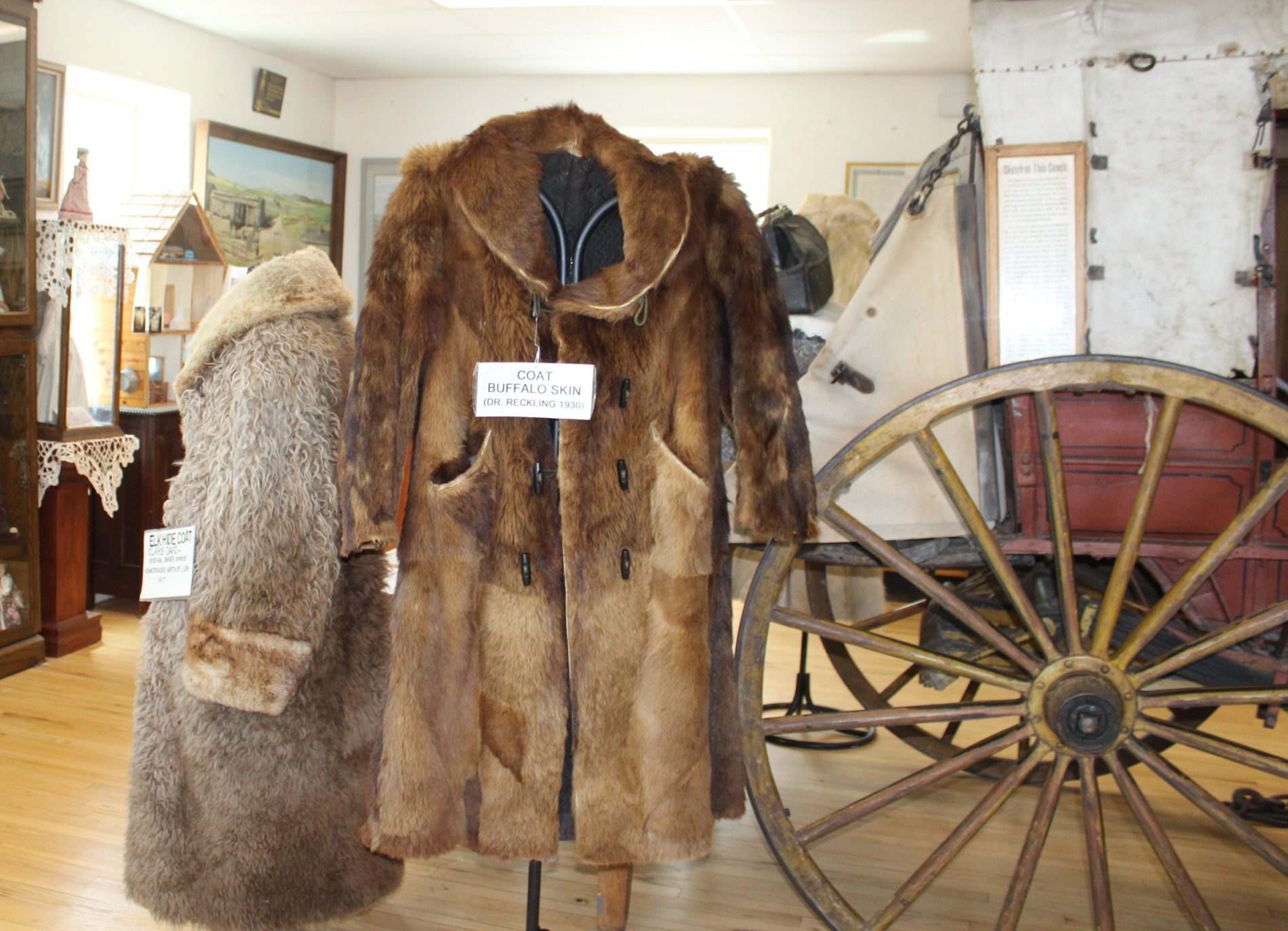
The Stagecoach Museum in Lusk, Wyoming features an authentic stagecoach that was used on the Cheyenne to Deadwood Stage and Express Line, as well as a great deal of information about the line.
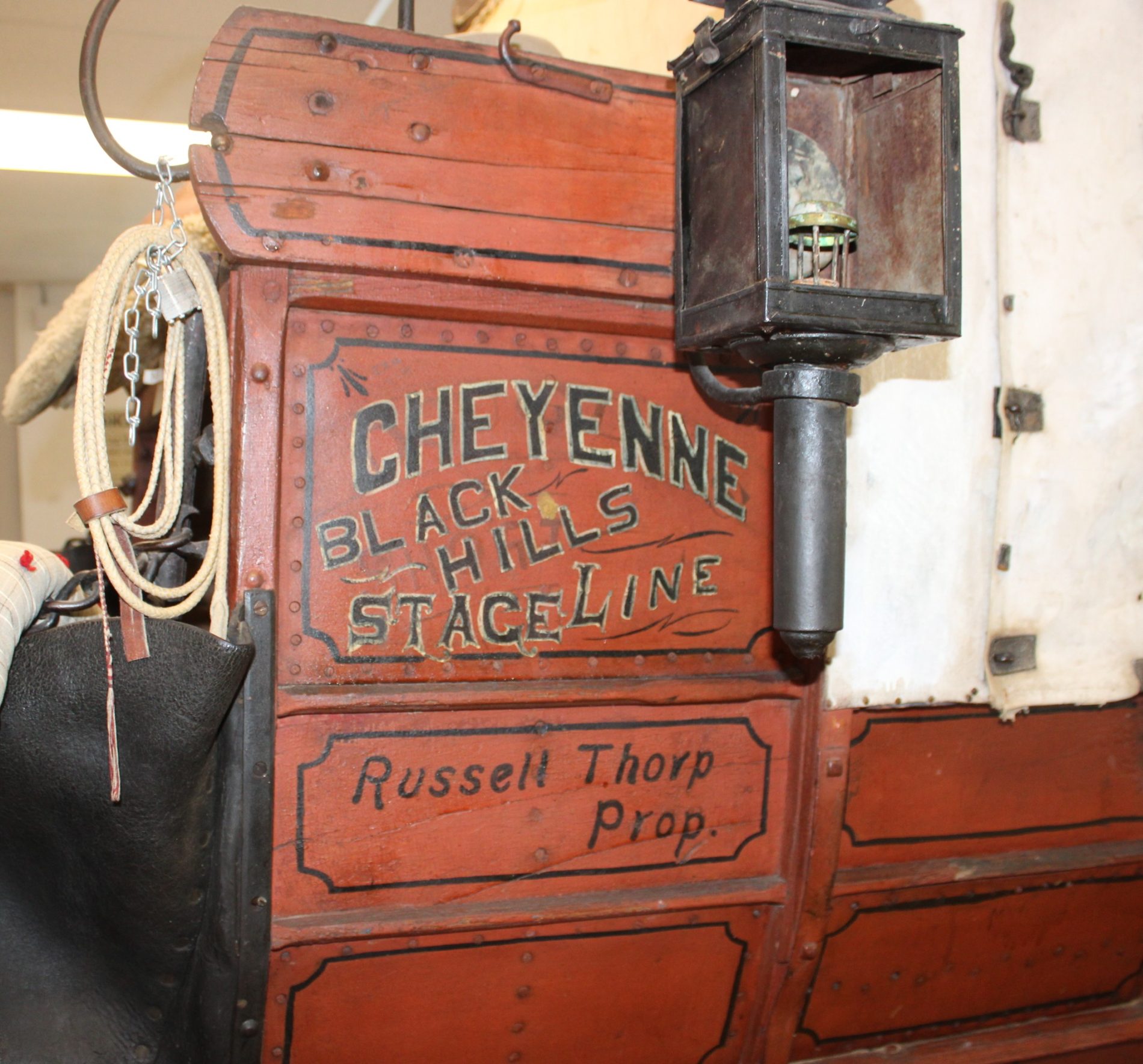
Up until the line was replaced by more railroad lines in the region, it transported thousands of passengers and as well as freight, including gold, a the U.S. Mail. The journey covered approximately 300 miles. Come along for the ride.
Cheyenne Daily Leader, April 1, 1877 – The Black Hills. Facts of Interest to Those Who are Going There. Cheyenne as an Outfitting Point. In answer to the many communications which we receive daily, we have compiled the following budget of Information, for the benefit of all those who are afflicted with the Black Hills fever. While it isnot as complete as we might desire and promise to make it, we think it will answer most of the questions asked. The first query propounded is whether we really believe there is gold in the Black Hills. This has been too well proven to admit of doubt. Good judges who have the means of knowing, estimate the amount of gold brought from the Hills during the year 1870, at million and a half of dollars; as much more remains undoubtedlyin the hands of miners and merchants in the several settlements; for it is only recently that the Cheyenne and Black Hills Stage company has commenced to carry gold dust with a guarantee of safe delivery. Gold is found in paying quantities in nearly all themining districts opened.
The richest discoveries in placer and quarts mining have, however, been made on Deadwood and Whitewood creeks, and along these creeks cluster the principal mining towns in the Black Hills. Owing to the hostility of the Indians the mountain ranges west and north of Deadwood received last year but little attention from the prospector; but it is known that that section also abounds in gold and silver, which during the present year will be brought to light by the hardy miner.
How to Reach the Black Hills. Without decrying any of the proposed routes from points on the Upper Missouri river, we assert that the route from Cheyenne northward is the safest, speediest, cheapest and best to reach the Black Hills. Cheyenne is at the junction of the two competing railroads from the East—the Union Pacific and Kansas Pacific. It will be two days’ railroad travel to Cheyenne from Chicago or St Louis.
The distance and the train fare from Chicago to Omaha was 490 miles, first class was $16 and second class was $13. Then from Omaha to Cheyenne, which was a distance of 516 miles the fares were $31 and $24.
As the coach leaves Cheyenne, the article continues. A fine natural road, over which the United States mails have been carried for many years, leads from Cheyenne to Fort Laramie, a distance of ninety mike. This route passes through a settled country, and good ranches are found at convenient distances from each other. From Fort Laramie to Custer and Deadwood City a good wagon road is found, which has recently been shortened by your county officers, thus reducing the distance necessary to be traveled by freight teams over sixty miles.
The whole distance from Cheyenne to Deadwood over this road is about two hundred and thirty-miles. The Cheyenne and Black Hills Stage company, Luke Voorbees, superintendent, makes at present tri-weekly trips over this road to Custer and Deadwood, carrying passengers, express matter and the U.S. mails. Early in the spring this company will put on a daily line of coaches and, with a superb outfit of horses and stages, well-kept stations at convenient points, and reasonable enlarges, this stageline will continue to be the only first-class line of communication between the Black Hills mining towns and the outside world. The Stage company sells first class tickets to Custer at $35.00; to Deadwood City, $50.00.
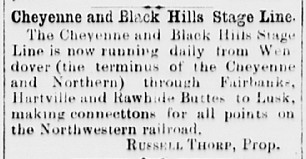
The Cheyenne Daily Tribune, October 10, 1888
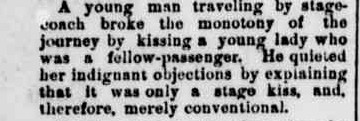
Stagecoach travel could sometimes be boring. This tidbit is from The Cheyenne Daily Sun, November 6, 1884
Stages ran year around, and sometimes, like today, winter travel could be difficult. This from The Hornet, (Cheyenne) March 12, 1878
One stage passenger describes some of the history and scenery from Lusk to Bordeaux, which was located not far from the present town of Wheatland, not far from Cheyenne.
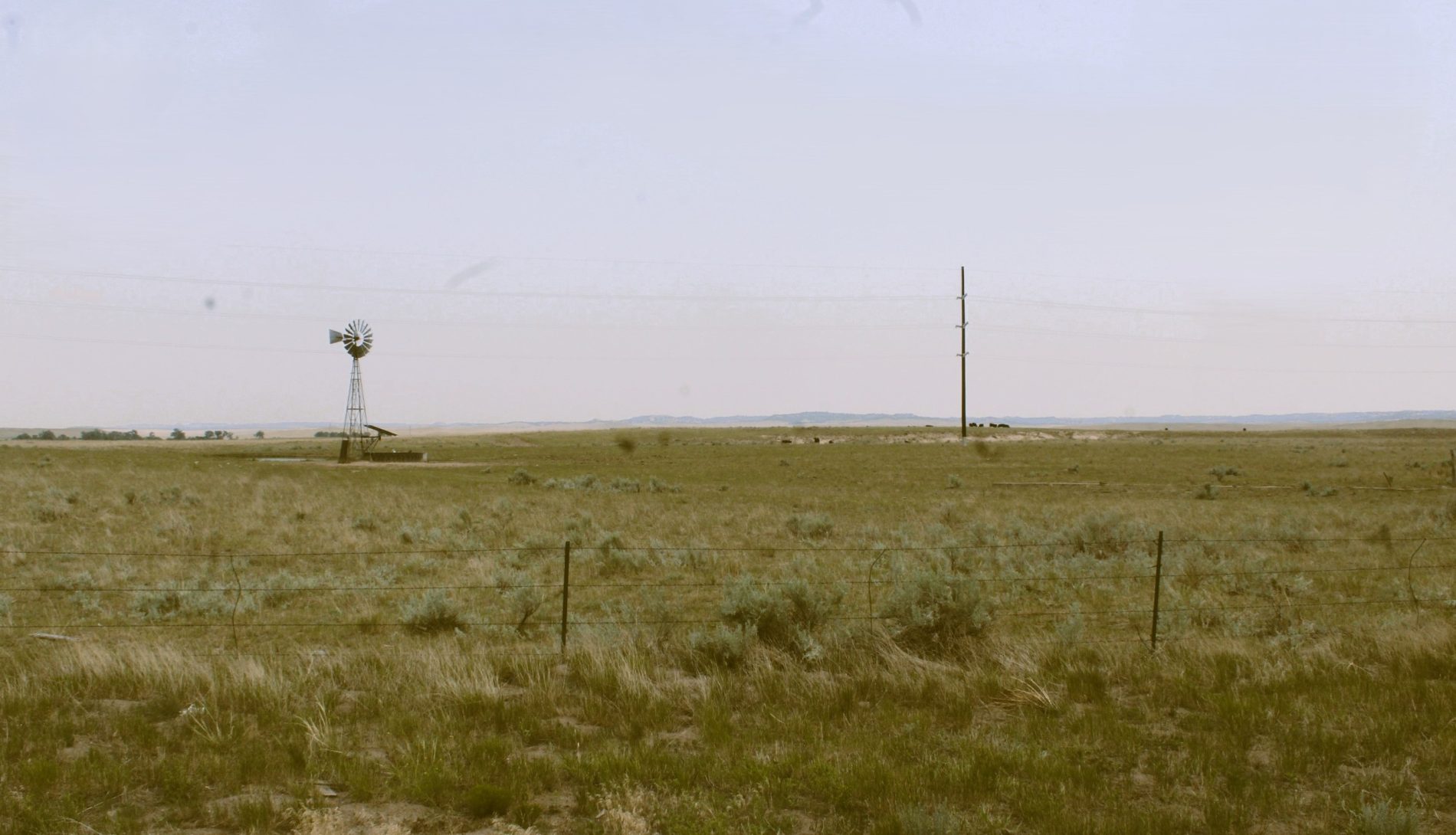
Scenery along the Cheyenne-Deadwood Trail between Lusk and Newcastle.
The Lusk Herald, August 19, 1887 – A Romantic Drive. The scenery to be found on the Black Hills stage line, between Lusk and Bordeaux. A short ride made pleasant by good roads, careful drivers and courteous agents. To the lover of the grand, beautiful and romantic, a ride from Lusk, on the Wyoming Central, to Bordeaux, on the Cheyenne Northern, presents an opportunity for the gratifications of these passions which is often sought through hardships and perils. When it is remembered that this route is the shortest, quickest and pleasantest one between the U. P. and all points in Central Wyoming, Western Nebraska and all Black Hills points, it is not strange that the fine daily four and six-horse coaches of this line areso well filled both ways.
The distance from Lusk to Bordeaux is about 75 miles, and is made in about fifteen hours of pleasant travel. Leaving Lusk at 2 p. m. the coach drives merrily southward over a slightly rolling landscape dotted with settlers cabins and covered with a verdant growth of our peculiarly nutritious grasses, or with waving fields of millet and small grain and gardens which rival in luxuriance those of tropical climes.
From this scene of quiet peacefulness the coach emerges to the famous Rawhide Butte whose rock bound and evergreen covered sides contain vast quantities of almost every mineral known to science. Here the hardy prospector has plied his pick and rocked his pan waiting for railroad facilities -now here, to bring him the happy realization of his golden dreams of wealth.
Descending a gentle slope beyond the summit you pass a small picket fence, which is pointed out as the last resting place of “Mother Fentherlegs,” a historical character, who in the days of the road agents kept a road ranch on the erstwhile dangerous route of the C.& B. 11 hinge line. She was thought by many to be connected with the deft plunderers who infested the road and was reported to have vast wealth in coin and jewelry stored away in her ranch house and secret cave in the hills. Be this as may be, she was shot, and the perpetrator of the crime escaped on one of her fleet horses.
Others, who met violent deaths also lie within this rude enclosure, but the gentlemanly driver can give you their history, thereby whiling away the pleasant hours on the road.
At an early supper hour you will draw up before Russell Thorp’s spacious and comfortable home ranch, where you are sure of an excellent meat and genial host, and will then roll on in the pleasant evening to Fort Laramie, one of the oldest and most historical of all western fortifications.
Here, as you sit and smoke in the pleasant “Rustic House” you will be regaled by anecdotes of enroll Indian troubles, and the daring adventures of hardy pioneers. Your stay here will be pleasant, as Laramie is a picturesque garrison which stands on west bank of Laramie river – indeed almost surrounded by that stream -one and a half miles from the confluence of the Laramie with the North Platte, of river.
This fort is closely interwoven in its history with the settlement of the west, its having been a fur trading post where Lewis & Clark’s great exploring expedition rested half a century ago, and protection of the pioneers from the murderous attacks of roving bands of red men, who until a few years ago, swarmed in the region which was the center of a vast buffalo range.
Next morning you will again enter the comfortable coach and pass on over the old Black Hills trail, where you will notice the names of prospectors rudely craven on the sides of rocky precipices — cut there when the mind of the workman was filled with golden visions of the wealth he would wrest from this new Eldorado and then return to his eastern home and family to enjoy peace and plenty. Alas, how few realized their fond expectations.
Two hour’s drive to brings you to that natural wonder, “Eagles’s Nest Canyon,” which is a grand piece of scenery, reminding the visitor of famous ‘Giant’s Causeway” and resembling to a remarkable degree the ruins of some ancient citadel.
It is but a short drive from this noble work of nature to Bordeaux, the present terminus of the Cheyenne Northern railroad, where you will regretfully leave the coach for the more modern, though perhaps less comfortable and romantic method of travel. Altogether this delightful drive is one no one who can cross this way should miss. Remember, it it is much shorter, quicker, cheaper and pleasanter than the route around by Fremont. Try It.
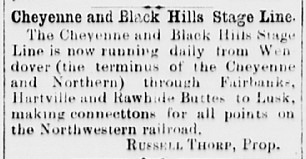
The Cheyenne Daily Tribune, October 10, 1888
For anyone interested in more about the Cheyenne-Black Hills Stage Line, there is an interesting handout at the Stagecoach Museum, titled, Traveling on the Cheyenne to Deadwood Stagecoach, a fictional account of riding on the stage. Although a fiction story, the incidents described in the story really happened. It was written by Leslie Stewart of Lusk.
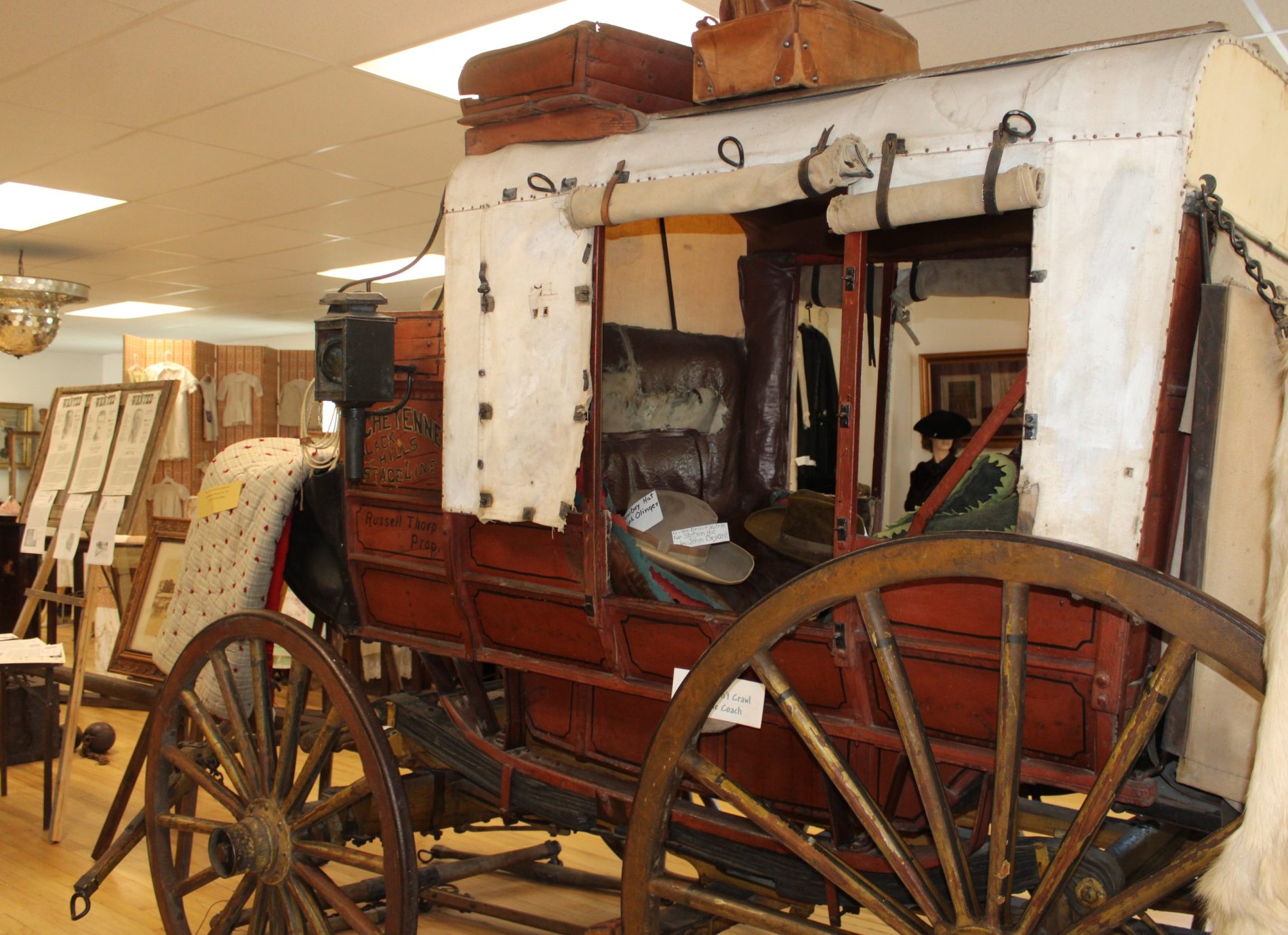
Photos of the stagecoach were taken in the Stagecoach Museum in Lusk. With thanks.
“}]]

More Like this



Last modified: July 20, 2026