
News – Sheridan Media
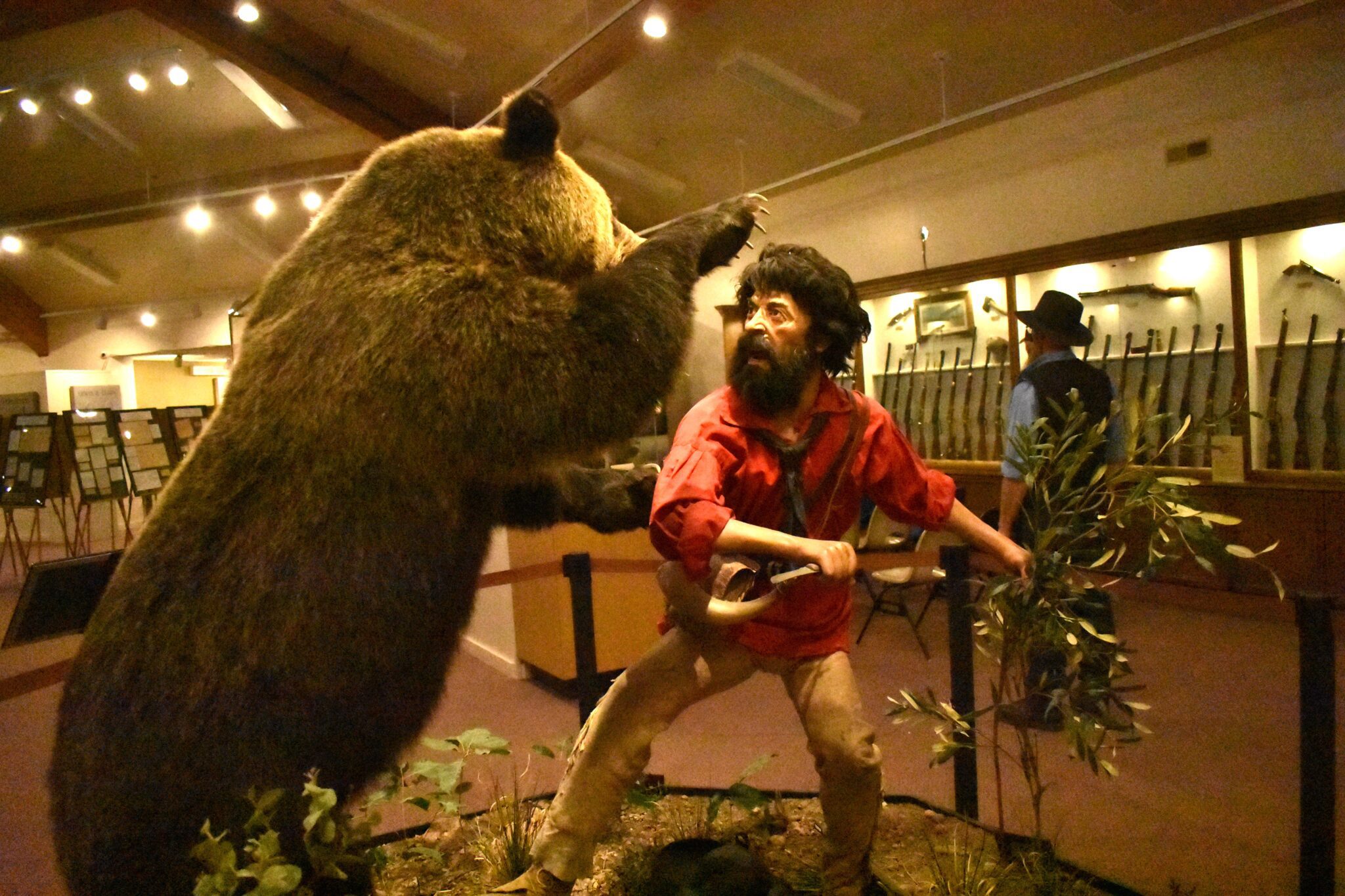
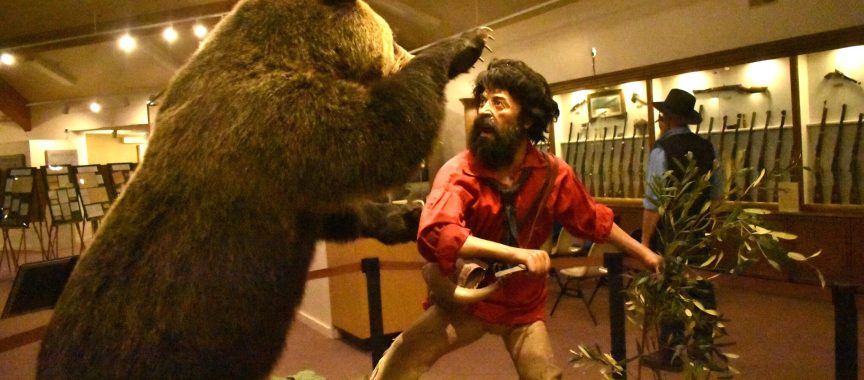
One of the most monumental stories of survival in the Mountain Man Era in the Rocky Mountains was the story of Hugh Glass, which happened in what is now Northern South Dakota. Glass was a trapper and hunter with the William Henry Ashley 1823 expedition. Glass was attacked by a grizzly bear and left for dead. This is his story.
The Sheridan Post June 25, 1922 – The Amazing Adventures of Hugh Glass – The king of wild beasts of the Rocky Mountains is the grizzly bear. While seldom encountered today excepting in the remotest and most inaccessible fastnesses of the Rockies, this monarch of the wilderness a century ago was the one animal which hunters and trappers considered really dangerous.
Grizzlies were called by the earlier explorers “whitebear,” and many were the narrow escapes related by members of the Lewis and Clark party and other frontiersmen who were attacked by monsters of this species and threatened with death in a terrible form. There were few among the mountain men who had not had disastrous experiences with the it at one time or another.
The grizzly bear is distinguished from other species of bear by a number of marked characteristics, such as facial profile, shape of anterior claws, color of hair and its lack of ability to climb trees. The color varies greatly, but there is usually enough white hair in its fur to give it a grayish color. In size the grizzly averages about six feet in length from nose to tail tip, although they have often been found nine feet, and some have measured as much as fourteen feet in length. A grizzly usually weighs about five hundred pounds, but of course the larger specimens weigh much more.
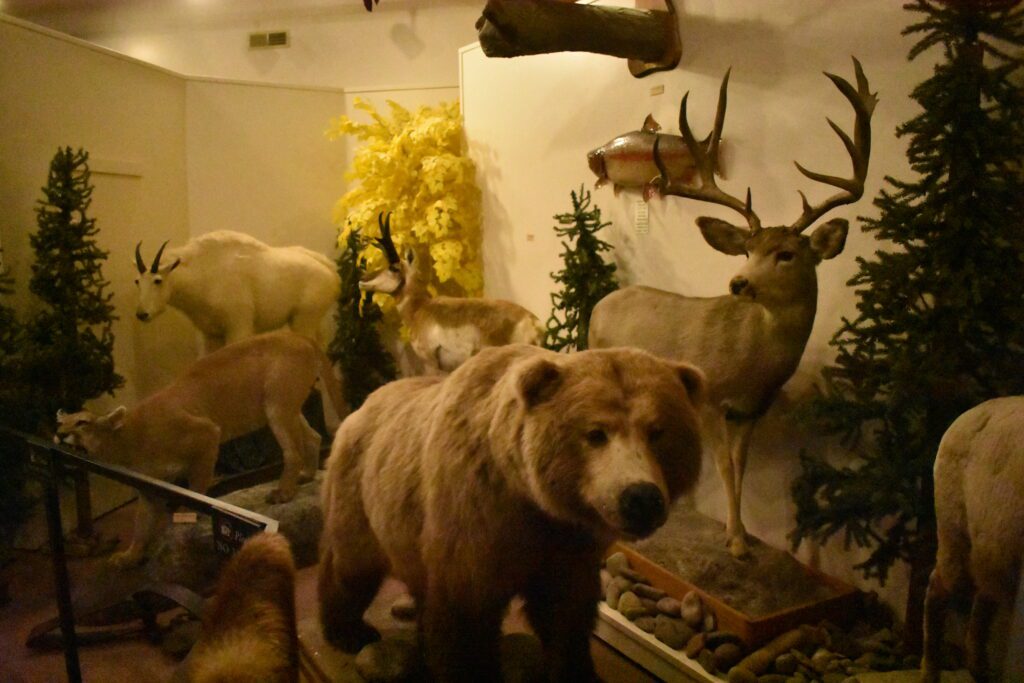
It is not only a most powerful brute, but is extremely tenacious of life. The male has the reputation of not being pugnacious, attacking a man without provocation and even when wounded often attempting to escape until brought to bay. A female, when her cubs are small, is savage and dangerous always. Either sex of the grizzly, when thoroughly aroused, shows terrible rage. Hunters often noticed that when struck a bullet, start instantly in the direction from without, waiting to see its enemy.
A shot through the heart frequently will not stop a grizzly. Many a man has been killed and horribly mangled by one of these brutes after it has been shot through the heart. The only really safe shot is between the eyes or behind the ear. Either kills instantly.
The most notable story of an encounter between a white man and a grizzly was that of Hugh Glass. Possibly this true tale, which was one of the most sensational happenings of the frontier a hundred years ago, has survived in the annals of the fur days because of the amazing facts involved in it that have to do with treachery and man’s grim fight to live to be revenged.
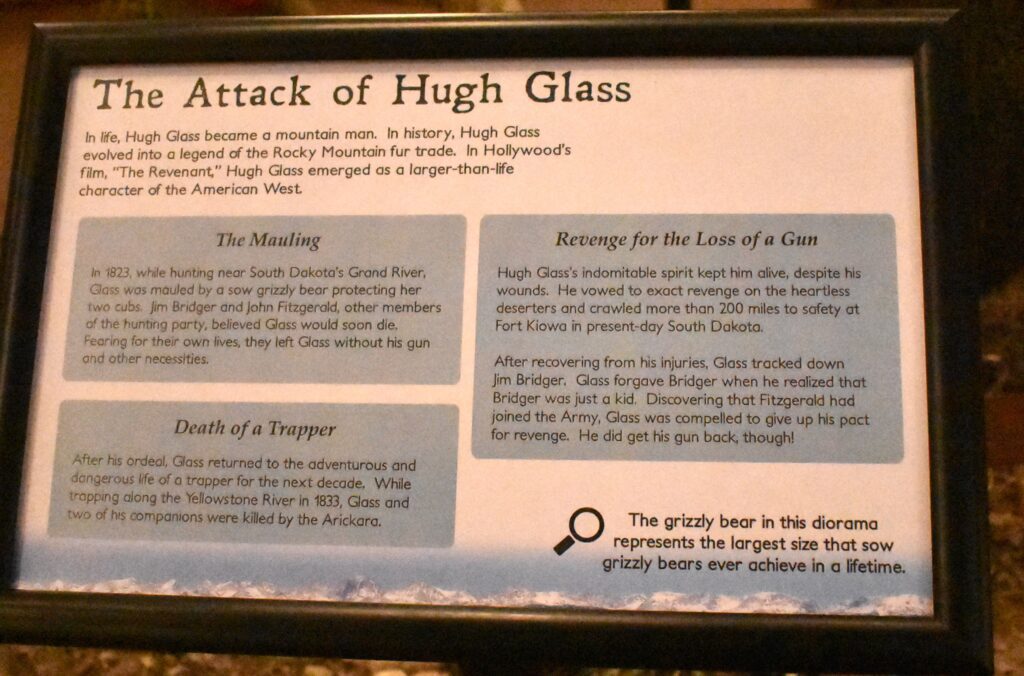
Glass was born in Pennsylvania, but nothing is known of his life before he enlisted with the second Ashley Henry expedition to the Rocky Mountains in 1823 and was wounded in a fight with the Aricaras on the Missouri River. He was then called an “old man,” and was one of the best marksmen and hunters of the party. Under Major Andrew Henry a party set out to trap beaver and explore the Yellowstone, river, and Glass was detailed as a hunter, an extremely important duty.
One morning he was in advance of the party, forcing his way through a thicket, when he suddenly came upon a monster female grizzly bear that rose, and charged at him before he had time to “set his trigger” or even turn to fly. The bear seized him by the throat and lifted him off the ground. Then hurling him down, the ferocious beast tore off a mouthful of his flesh. Then she lumbered to her her cubs, which were close by. Glass now tried to escape, but the bear, followed by her cubs, attacked him again. Seizing him by the shoulder she crunched his hands and arms between her teeth.
Deserted by Companions, Glass is Left for Dead in Wilderness Glass was in a terrible condition and had given himself up for dead when a companion detailed also as a hunter appeared and shot at one of the cubs. The other, a half-grown bear, drove him into the water, where he stood waist deep and killed his pursuer with a shot. Just then the main body of trappers arrived, having heard cries for help. A dozen guns cracked and the mother bear fell dead over the prostrate Glass. It was found that he was still alive, but in an apparent hopeless condition.
His whole body was mangled, he could not stand and suffered excruciating pain. No surgical aid could be given and it was impossible to move him. Delay of the party in this hostile Indian country might mean disaster to all, and a lengthy council was held to determine what course to take.
Finally Major Henry induced two men by a reward of eighty-two dollars to remain with Glass until he should expire, as not the slightest hope for his life was entertained. These men stayed with Glass for five days, when, despairing of his recovery – and yet seeing no prospects of his immediate death cruelly abandoned him, taking with them his rifle and all his accouterments, so that he was left without any means of defense, subsistence or shelter.
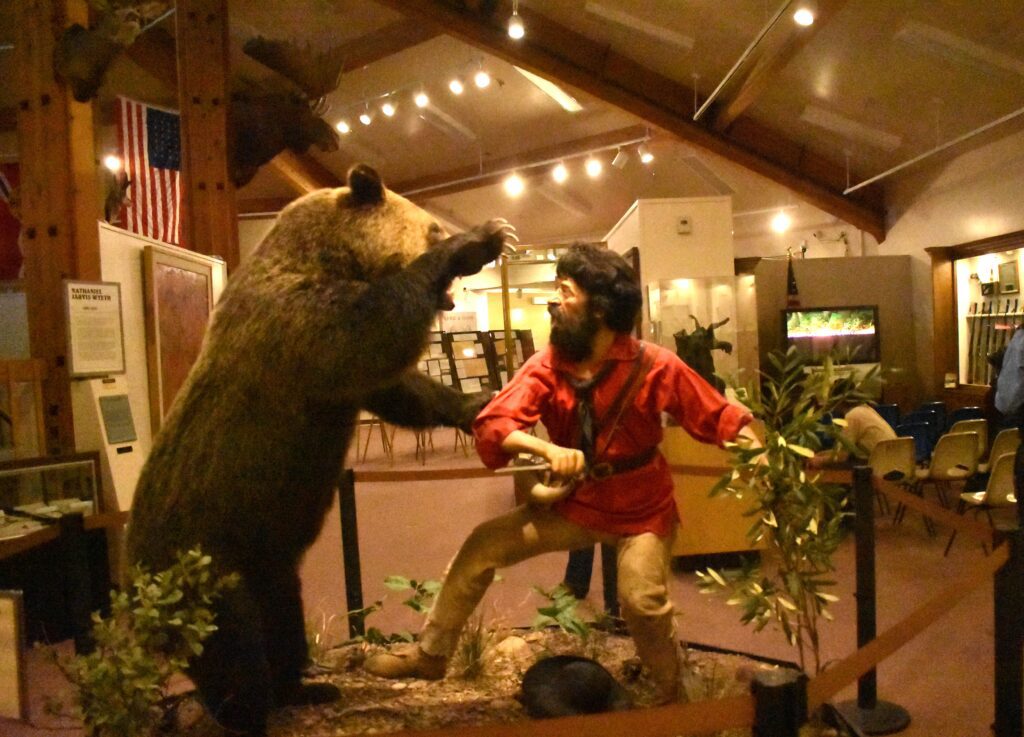
The pair then out on the trail of Major Henry’s party and when they over took them reported that Glass had died of his wounds and that they had buried him in the best manner possible. They showed his belongings and their story was not doubted by anyone, But Glass was not dead, and entirely helpless, he managed to drag himself
He manged to draw himself to a spring over which hung buffaloberry bushes and a few branches containing wild cherries. Glass managed to pick enough berries to keep from starving. Gradually he nursed back his strength until he at first could crawl and then slowly and painfully walk.
His plan was a sufficiently desperate one, but offered the only chance for life. It was to strike out for Fort Kiowa, a trading post on the Missouri hundred miles away. With hardly strength enough to drag one leg after the other, with no provision or means of obtaining any, in a hostile Indian country, he started.
Upheld only by the deep-set purpose of living to hunt both the men who had deserted him, he made mile after painful mile.
Suffering from Terrible Injuries Walks 100 Miles for Revenge One evening he came upon a pack of wolves that had surrounded a buffalo calf and were attacking it. Glass waited until it was dead, and then shouted and brandished a stick frightening the animals away. He had no knife and no fire, but he managed to tear off enough meat from the calf to make a meal, and eating sparingly, it gave him strength. When he felt able to go forward, he took as much meat as he could carry, and finally, after hardships and distress incredible, he reached Fort Kiowa, where he rested for a few days. (Even before he was in any condition to travel, he joined another party of trappers bound for the Yellowstone. He wanted to retract his steps in the hopes of meeting Henry’s party and extract his revenge on those who what wronged him.)
After traveling along for thirty-eight, days he at length arrived at Henry’s Fort, near the mouth of the Big Horn River, on the Yellowstone. The amazement that his appearance occasioned maybe imagined as it was thought he was dead and had been in his grave for weeks.
He was bitterly disappointed to find that the two men who had deserted him had left for Fort Atkinson, on the Missouri river… Still intent on revenge he accepted service as a messenger to carry a dispatch to Fort Atkinson, and with four men left Henry’s fort on the Yellowstone on February 28th,1824….. (After encountering a tribe of Indians and problems there, Glass continued his quest) At the first opportunity he left with a keelboat party bound down the river and reached Fort Atkinson in June. Here he found one of his faithless comrades, who had enlisted in the army. The other had gone, and he never heard of him again. Glass at first meditated killing the man, but after a talk with the commanding officer, he was persuaded that to do so meant an immediate trial and death for himself. The officer called m the man whom Glass sought and the man nearly fainted when he saw in the flesh one whose bones he supposed were scattered over the prairie hundreds of miles away in the Upper Missouri country. Glass expressed his feeling of contempt for the man who had left him to die, but on being given a completely new outfit of rifle, ammunition and other necessaries, he relinquished his plan of revenge. Shortly afterward he left again for the fur country to the west.
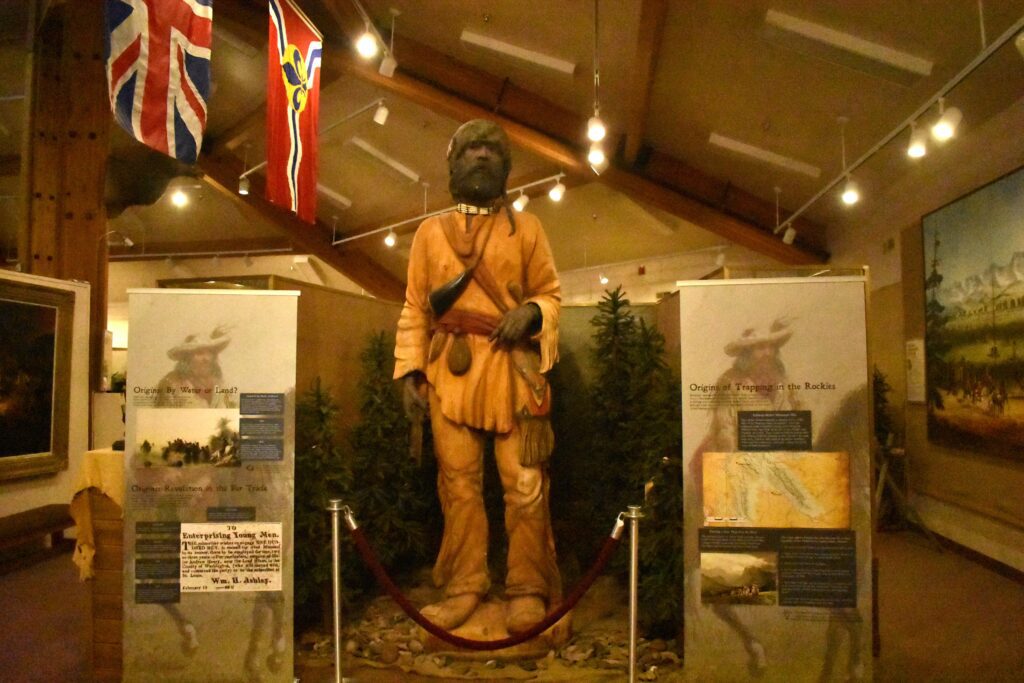
This is a shorter story from the Hudson Hearld Hudson, Wyoming, December 7, 1923.
The Living Ghost Of Hugh Glass: Hugh Glass was one of a party of free trappers when into the Upper Missouri country nearly one hundred years ago when, with a companion, known only by the name of Bill, came across a grizzly bear at which the men fired but failed to inflict a mortal wound. The bear charged and the two men fled.
Glass had almost made it to safety when he tripped over a stone and fell. As he rose to his feet, it reared up in front of him and the beast went into a clinch. What followed a terrific combat a knife against fang and claw. Badly wounded, with his scalp almost torn off, Glass sank to the ground unconscious.
Bill, seeing Glass fall, kept running until he reached the camp. The captain of the band sent two men back with orders to stay with Glass if alive or to bury him if he were dead. They found the bear dead from several knife wounds and lying on Glass, who was still breathing. Believing that he could not live for more than a few minutes, the two stripped him of his hunting moccasins and riding back to camp reported that they had buried him.
Months later at the trading post where the trappers had gone with their beaver packs, a man whose was so disfigured that there was not a feature recognizable, rode up to the post.
In a hollow voice this strange apparition said to him: “Bill, my lad, you thought I was gone this time, did you? Well, hand me my horse and gun, my lad. I am not dead yet, by a damn sight.
It was Hugh Glass, whom the trappers believed dead and buried all these months. The tale which Glass told was of suffering and human endurance unparalleled in history.
He did not know how long he had remained unconscious. For days he lay beside the carcass of the bear, feeding up until he gained strength. Then, without a weapon, even a knife, he crawled away. In spite of his unhealed wounds, starvation diet of roots and berries, his iron will drove him on until he reached the fort more than 100 miles away. He had determined to live for the sole purpose of having revenge on his faithless friend, Bill, who had so basely deserted him. Bill nearly dropped dead with terror at the sight of this living ghost and he continued to live in fear until Glass, whose generosity was as great as courage, forgave him and renounced his revenge.
One part of the Glass story which has been often repeated was that one of those abandoned him was young Jim Bridger. But some primary sources say the name of the young trapper was ‘Bridges’. Probably history will never know.
Whether Bridger was involved or not, the story of Hugh Glass is an incredible story of survival and the indomitable human spirit.
All photos taken at the Museum of the Mountain Man, Pinedale, with thanks.

More Like this




Last modified: June 23, 2025