
News – Sheridan Media
[[{“value”:”
With many people today watching the journey of the four astronauts in Artemis II leave earth on a 10 day voyage to fly past the dark side of the moon and come safely back to earth, as well as many people who watched the Apollo missions, it is fun to look back in history and see what the early day Wyomingites thought of the our nearest satellite.
Science fiction, they say, often becomes science fact, and the When Apollo 11 first landed astronaut Neil Armstrong mentioned a part of Jules Verne’s 1865 novel “From the Earth to the Moon.” Verne is considered to be the father of science fiction, as well as inspiring future space exploration.
For centuries, man has looked at the moon and wondered if man would ever set foot on our nearest space neighbor.
Rock Springs Rocket, August 20, 1908 – Can men travel to the moon? If in any age but the present this question, if seriously asked, would have been answered by a chorus of jeers. So far beyond the pale of possibilities has the visiting of other worlds always appeared that writers of fiction have felt free to treat the idea sportively, describing thrilling journeys through outer space in impossible vehicles.
Nevertheless the thought of exploring distant planets, pausing enroute to view the further side of the moon, go tantalizingly turned from us, is one that fires the human imagination most profoundly.
As we now know, Artemis II recently circled the ‘dark side’ of the moon, and saw what no human has ever seen.
The worst that can be said is that it now looks as difficult to us as the crossing of the great Atlantic must once have appeared to the naked savage upon it. The impossibility of the savage became the triumph of Columbus, and the daydream of the nineteenth century may become the achievement even of the twentieth.
Anybody on the earth’s equator is traveling with the earth’s rotation at a speed of more than a thousand miles an hour. If relieved of gravity it would not fly suddenly off, like a cannon ball, and disappear into space.
For several seconds its rise from the surface of the earth would be go slow as to be practically imperceptible, owing to the small difference between a straight tangent line and the earth’s slow curvature. Gradually, however, its apparent upward velocity would increase, so as to lift it some 65 yards the first minute, and more than a hundred miles the first hour.
It would travel 839,000 miles, the distance between the earth and the moon, in ten days; and if suitably exposed to the earth’s attraction, acting as a brake, while screened from that of the moon, its landing could be made gentle and safe. Strangely enough, the un turning attitude of the lunar surface in relation to the earth makes the return voyage absolutely impossible save by a tedious roundabout journey of many months, involving the circumnavigation of Man.
His query may now arise: “What is the moon good for, even if man succeeds in reaching it?”
We know it to be a barren, rocky world, without air or moisture, unspeakably cold at night, and below the freezing point even at noon. However, men could abide there for a time in thick-walled, air-tight houses, and could walk out of doors in air-tight divers’ suits. Scientists would find in the lunar wastes a fresh field for exploration. Astronomers could plant their telescopes there, free from their most serious hindrance, the earth’s atmosphere.
Tourists of the wealthy and adventurous class would not fail to visit the satellite; and costly hotels must be maintained for their accommodation. Then it is quite probably that veins of precious metals, beds of diamonds and an abundance of sulfur might be discovered on a world of so highly volcanic a character.
The foregoing may seem filled with “the stuff that dreams are made of,” yet most of the assertions are based on the hard facts of mathematics and physics. History is not always particular to follow the precise path laid out for it by prophets, yet in the long run it never fails to achieve larger things than the seer dared to predict.
Is it too much to suppose that after visiting the Queen of Night, our only near neighbor, pioneers will try the long voyage to Venus, Man and other planets of our system, finding some of them even more interesting, more inviting and more useful to man than the pale moon, which first tempted him to try his wings in outer space?
When President Trump decided to send more astronauts into space recently, one of his objectives over time would be to create a station on the moon, as a ‘jumping off’ point should the United States decide to explore deeper into space, maybe to the plant Mars.
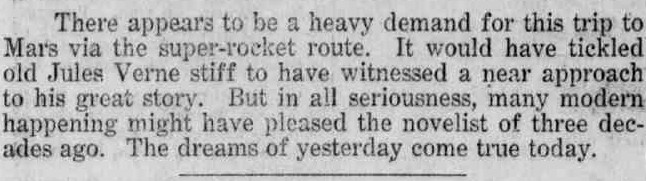
The Sheridan Post, March 20, 1920
Not only were people wondering if we could travel to the moon, they also wondered if there was life on the moon. In this story, the writer says there is proof of no life on the moon.
The Enterprise, October 7, 1905 – No Life On The Moon.The Proof we Have That our Moon and Neighbor is Uninhabited. The moon being much the nearest to us of all the heavenly bodies, we can pronounce mom definitely in its case than in any other.
We know that neither air nor water exists on the moon in quantities sufficient to be perceived by the most delicate tests at our command. It is certain that tbe moon’s atmosphere, if any exists, is less than the thousandth part of the density of that around us.
The vacuum is greater than any ordinary air pump is capable of producing. We can hardly suppose that so small a quantity of air could be of any benefit whatever In sustaining life. An animal that could get aloug on so little could get along on none at all.
But the proof of the absence of life is yet strouger when we consider the results of actual telescopic observation. An object such as an ordinary city block could be detected on the moon. If anything like vegetation were present on its surface, we should see the changes which would undergo in the course of a month, during one portion of which would be exposed to the rays of unclouded sun and during another to the intense cold of space.
And yet, another scientist feels he has proof that the moon can support lower life forms at least.
The Pinedale Roundup, May 16, 1906 – Is there Life on the Moon? – There was a time in the history of the earth when it had no satellite, when it was not the globe we know it now, but a great liquid planet encrusted by a shell some thirty-five miles in thickness that time is separated from us by an interval which cannot be accurately determined, but which must be measured by millions of years nt least. In those early days of Its planetary career, the earth spun on its axis with a constantly increasing swiftness that reduced the day to a few hours.
When the period of revolution had finally dwindled to a bare three hours, a catastrophe occurred, one of the most fearful in all celestial history. Such was the enormity of the centrifugal force of the earth, that five thousand million cubic miles of its mass were hurled off Into space. In that cataclysm our moon was born. Strange as its origin may be, the moon has still other peculiarities to offer. It is the largest of all planetary satellites, so large indeed that to the inhabitants of a neighboring world it must appear with the earth as a marvelously beautiful double planet. Because it is smaller in mass than the earth, the attraction of gravitation on the moon is considerably less than it is on the earth.
If it were possible for one of us to journey to the moon and live there we should find ourselves able to accomplish six times as much as we can on We could lift weights six times as heavy, run six times as fast, work six times as hard— all because the moon attracts bodies with but one-sixth the force of the earth. We could leap over barns with ease, and run a mile at express train speed.
Despite the chasm of 253,000 miles that separates us from the moon, we know more of the physical characteristics of the single pallid face which it ever turns toward us than we do of the Arctic regions, or of the heart of Africa. We have studied, mapped and photographed the great dark plains which were once thought to be seas and were accordingly miscalled “maria;” the lofty mountain ranges that sometimes tower 20,000 feet above the seas, and the vast, annular craters that pit the moon’s aged features. Although it once formed part of the earth, the moon is different from our globe in many respects.
Charred by by fires long since dead, honey-combed like a giant ball of slag, scarred by terrific volcano upheavals, its telescopic aspect la anything but cheerful. Craters are not uncommon features of the earth, but on the moon their number and size are truly astonishing. At the lunar south pole these dead volcanoes are so closely packed together that to Galileo (The first man who ever saw the moon through a telescope) they seemed like the eyes of a peacock’s tail. So large indeed, are many of these craters that man standing within one of them would be unable to see the surrounding ramparts because they would lie below his horizon. A diameter of ten, twenty or even sixty miles is not infrequently met within a lunar crater.
Are these craters all dead? Most astronomers believe so, but Professor W. H. Pickering, of Harvard University, has recorded a number of observations that seem to point to the activity of a few of them at least. He relies chiefly on the fluctuations in size which have been observed in a comparatively small crater called Linne. On an old map one observer recorded Llnne as a crater of moderate size. A century later it is described as a small, round, brilliant spot. When modern instruments of precision were invented the crater was measured repeatedly, with decidedly surprising results. Once its diameter was four miles; then it grew to six miles, and now it has shrunk to three-quarters of a mile. If this volcano extinct, how comes it that it changes Its size so strangely? Still another proof of activity is found by Professor Pickering in the eccentricities of a gigantic crater called Pluto, and in dense clouds of white vapor which have appeared before his eyes, rising from a tortuous cleft known as Schroeter’s Valley. So minute have been Professor Pickering’s observations that their accuracy can not be seriously called into question.
Granting that a few of the moon’s craters are active, it follows that they they must discharge something into space. That something, judged by our earthly volcanoes, must be water and carbonic acid gas Because the pressure on the moon’s surface is exceedingly low, and because the temperature during the long, cold lunar night is probably not far from 400 degrees F. below zero, water con not possible exist in a fluid state. Ice and snow are the only forms of water can assume.
Is there any evidence of snow and ice? Almost every crater in lined with white. The lofty peaks of mountain ranges are hooded in white. At the South Pole the white glare Is utmost blinding. What is this white sheen? Merely the natural color of the moon’s wrinkled face, according to most astronomers— snow and ice. Forming where It should form, according to Professor Pickering. The disappearance and reappearance of these white spots are admirably explained by this theory; for snow and ice would vaporize in the long lunar day, equal to fifteen of our days, and congeal again in white crystals as the sun sets.
Is there any reason why life in its lowest forms at least, may not exist on the moon. Professor Pickering believes that he has discovered traces of vegetation. There are variable spots that darken after sunrise and gradually disappear toward sunset. They are not shadows, for they are most pronounced when the sun is high in the heavens.
They appear quickly at the equator, and encroach on the higher latitudes after a few days have elapsed. They are never seen in the polar regions. It is In these variable spots that Professor Pickering has discovered what he considers to be vegetation. Whether he is right or wrong this much is certain: He has explained with admirable simplicity a phenomenon that has long puzzled astronomers. To offset the objections that the temperature of the moon is too low to support organic life it may be answered that certain lichens thrive in our own Arctic regions, where the temperature rarely rises above the melting point of ice.
Moreover, many bacteria resist the most intense cold that we can produce. It may be objected that In a single day vegetation cannot grow appreciably, but on the moon a day is equal to fifteen of our days and may well be likened to a miniature season. The advances which have recently been made In selenography by Professor Pickering show that although the moon is not a riotously luxuriant abode it is anything, but the lifeless orb commonly supposed. It may be desolate and cold, but it is not altogether dead.
There were, a one time, several theories about the moon. One was that it was made of ‘Green Cheese.’ However, as we see in this short story from the Cheyenne Daily Leader, October 4, 1871, that story was easily debunked.
Very often we find true wisdom in the utterances of even the youngest children. You have all noticed or heard of illustrations in your own experience.
One little girl, six years old, was on a visit to her grandfather, who was a New England divine, celebrated for his logical powers.
‘Only think, grandpa, what Uncle Robert says!’ ‘ What does he say, my dear ‘Why, he says the moon is made of green cheese. It isn’t at all, is it?” ‘Well, child, suppose you find out for yourself.’ “How can I, grandpa” ‘Get your Bible, and see what it says.’ ‘Where shall I begin?’ ‘Begin at the beginning.,’
The child sat clown to read the Bible. Before she got more than half through the second chapter of Genesis and read about the creation of the stars and animals, she came back to her grandfather, eyes all bright with the excitement of discovery. ‘ I’ve found it, grandpa; it isn’t true; for God made the moon before he made any cows. She was certainly a ‘chip off the old block,’
Youngsters were also told to look for “The Man in the Moon,” as the craters sometimes almost form a human face.
The moon. Queen of the Night. Just the fact that it is there above us has fired man’s imagination for many, many centuries. Today, with the wonders of technology, to be able to see up close photos of the moon, is totally amazing.
“}]]

More Like this




Last modified: April 13, 2026